
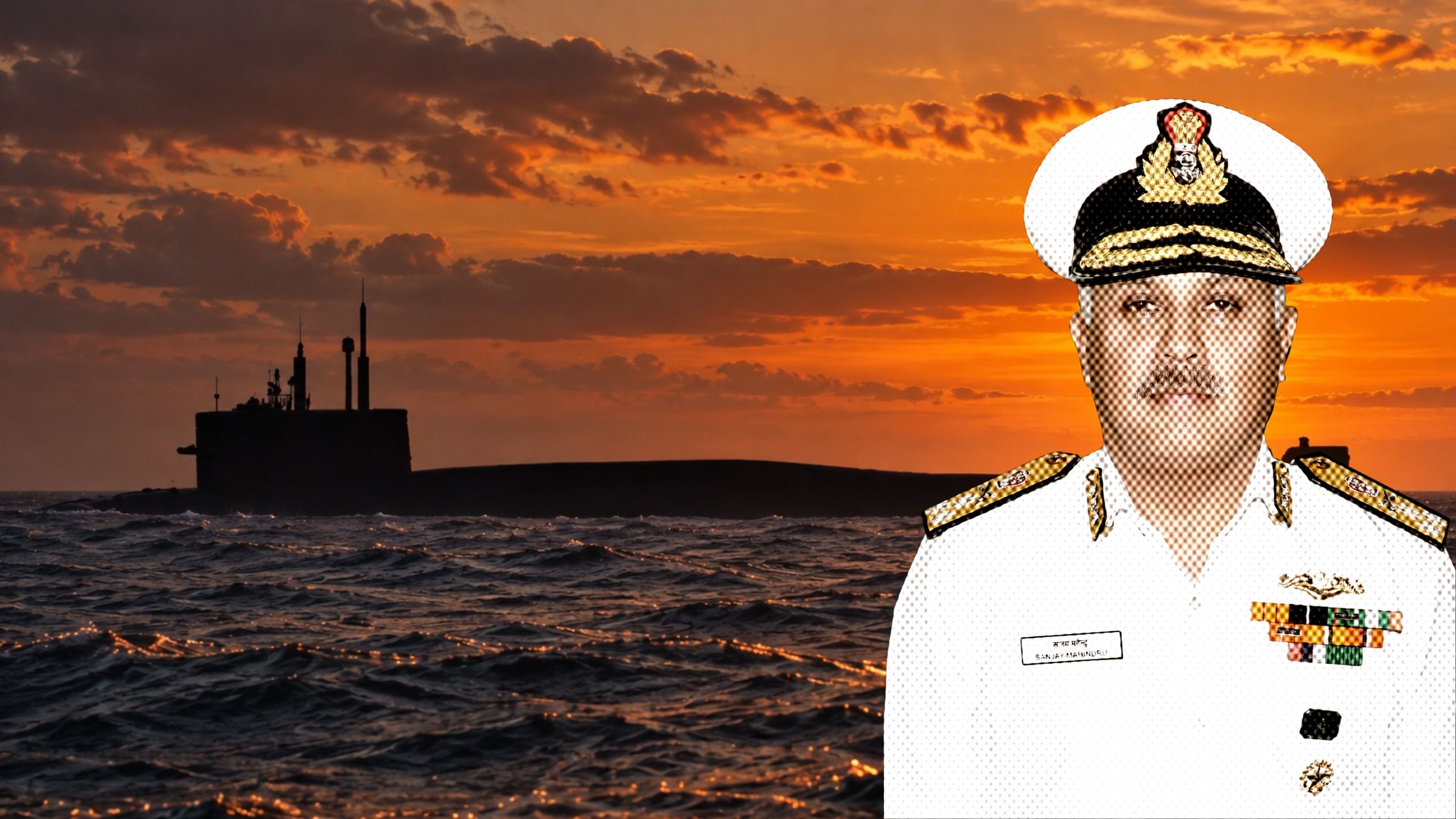
In a first for defence news from India, Vice Admiral Sanjay Mahindru (Retd), the commissioning commanding officer of INS Arihant (S2), India’s first indigenous nuclear-powered ballistic missile submarine (SSBN), has spoken publicly for the very first time about his decade at the helm of the most secretive program in the nation’s defence history.
Speaking on Episode 56 of the Ctrl+Alt+Defence podcast, co-hosted on NDTV by Livefist founder Shiv Aroor and senior defence journalist Vishnu Som, Admiral Mahindru pulls back the heavy curtain of secrecy surrounding the Advanced Technology Vessel (ATV) project. He offered rare, granular insights into reactor criticality, missile launches, underwater acoustic stealth, deterrence patrols, and the human cost of living inside a steel cylinder under extreme conditions.
For decades, the men who commanded India’s strategic nuclear assets operated entirely in the shadows. As Admiral Mahindru noted with characteristic dry humor during his debut interview:
“Submariners are generally trained not to talk too much about what they do, so it’s an occasion to relive some of the more pleasurable moments of one’s life.”
The Birth of Criticality: August 10, 2013
The long journey to operationalizing India’s nuclear triad reached its defining technical milestone inside the quiet, sanitized confines of the submarine’s reactor compartment at Visakhapatnam. Admiral Mahindru recalled the exact sequence of events leading up to the moment INS Arihant’s 83-megawatt pressurized light-water reactor (PWR) went critical for the first time.
On August 10, 2013, after rigorous pre-checks overseen by top officials from the Department of Atomic Energy (DAE) and the Indian Navy’s nuclear safety apparatus, final clearances were sought.
“Arihant went critical on the 10th of August 2013,” Admiral Mahindru recalled. “In DAE parlance, you have one man who is the station in charge. Now, we hadn’t anticipated that question. Finally, the Inspector General Nuclear Safety was there, and the Flag Officer Submarines looked at me and said, ‘This guy’s in charge.’ I didn’t know because we were not prepared, but we managed to answer all his questions over the next 45 minutes… ‘If this happens, what will you do? If this happens, what will you do?’ So we went through all that, and that was the start point.”
Describing the technical reality of achieving nuclear criticality inside a naval vessel berthed at harbor, Mahindru explained the delicate mechanics:
“First approach to criticality is when you just get your reactor going and you can light maybe a battery bulb. That kind of voltage is created. It is extremely controlled, and it is a big thing actually. You have to put a source to start the fission reaction for the first time. The fuel is always there, but you have to start it and then you control it by lowering or lifting the rods just to the right height very, very gradually.”
While initial criticality was achieved alongside the jetty, reaching 100% full thermal power required the cooling efficiency of open ocean waters. That milestone came two years later, on the freezing night of December 15, 2015.
“Normally, you would achieve 100% power at sea because you don’t have enough water flow, cooling, and temperatures are not good enough in harbor,” Mahindru explained. “We did it on the surface first. It was the 15th of December… a cool period. Sea surface temperatures are low, and that’s what you look for when you are trying to cool stuff at sea.”
The “Hotel California” Crew: Leaving Harbor with Parrikar
For the crew that spent nearly a decade bringing the secret boat from a shore-based hull to an operational warship, emotions peaked on December 14, 2015, as INS Arihant cast off lines to head into open waters with then Defence Minister Manohar Parrikar on board.
Due to the unique, high-security nature of the project, the original core team remained intact for years, earning the submarine an affectionate internal nickname.
“One of the great things we did in Arihant was that the crew did not change,” Mahindru shared. “We got together in 2006, and largely most of us stayed. We went out for appointments and came back. So they used to call it ‘Hotel California’ – you can check out anytime you want, but you can never leave! My crew was always like that. Leaving harbor that morning with Mr. Parrikar there… we had manifested that moment for a decade almost. Most of us were in tears as we were leaving harbor. Not a good thing because you’d rather have your sight clear to see navigational marks, but we had gone through it in our minds and rehearsed all the orders to such great detail.”
“Fire. Okay, That’s It”: Missile Launches from the Deep
Following sea trials and power ascension, INS Arihant transitioned to proving its strategic primary role: firing ballistic missiles from underwater vertical launch silos. The boat conducted test firings of the B-05 (K-15) short-range submarine-launched ballistic missile (SLBM) across various operational parameters.
“We did a series of launches of the B-05,” Mahindru detailed. “First, a pop-up test which just pops the missile up and pushes down. Then you go to minimum range, maximum range, and then a salvo firing. Many things are to be checked. We made sure that the entire cycle is followed as it would be followed if the balloon goes up. You had to get the codes from your stations, receive them, your systems had to decode it, it had to be entered into the system, preparations done, and then launched.”
Despite the immense strategic gravity of firing a nuclear-capable missile from beneath the surface, the atmosphere inside the control room remained eerily subdued.
“You’ll be surprised when you do a torpedo firing or a missile firing, the level of excitement is very low,” Mahindru revealed. “Somehow, we are taught and trained not to get excited about life. You’ll be holding a cup of coffee and say, ‘Fire.’ ‘Okay, that’s it.’ So you fire, it goes off, and then you say, ‘Great, yeah, well done, good job guys.’ That’s the ethos… this is a part of your business, don’t get too excited about it.”
Addressing international skepticism surrounding SLBM test record variations, Mahindru emphasised that developmental testing is designed to absorb failures to achieve mature reliability:
“I won’t say we’ve had no failures. That would be a wrong statement to make. We’ve also had our failures, but it’s a technology you have to understand. As far as mastering the technology, in our root cause analysis we understand what went wrong and then improve… Doing a salvo firing from a submarine of this size when I am actually becoming heavier because I’ve taken so much volume of water into that container… I’ve got to have a full control system which keeps me stable. You cannot launch two, become heavy, and start going down. We have mastered those control systems.”
Strategic Reality: Deterrent Patrols and Strategic Silence
In 2018, Prime Minister Narendra Modi publicly announced that INS Arihant had successfully completed its first official deterrence patrol, completing India’s strategic nuclear triad. Responding to external debate about the operational nature of that deployment, Admiral Mahindru was unequivocal:
“When we say we’ve done a patrol, we’ve done a patrol. There was no doubt about it. The Prime Minister of the country will not come up and say ‘welcome back guys’ after having a relatively short patrol without substance… There is no other thing called a patrol. What patrol are you doing without tops? It’s like saying I’m going out on a patrol without torpedoes! What patrol are you going out for?”
When asked to compare India’s emerging SSBN capability with China’s Type 094 (Jin-class) fleet, Mahindru highlighted command-and-control stability over raw missile range metrics:
“With our open-source understanding of the Chinese, we are not very clear whether they have ever carried out an operational patrol with nuclear warheads on board or not… In the command and control side, their whole organization is not very clear to us. You have the PLA Rocket Force, the PLA Navy, the Central Military Commission. With all these firings going on, especially in the PLA Rocket Force, does the leadership have the confidence to hand over nuclear warheads to a person whom you are firing every third day? Command and control to me itself is a big question on that sense.”
Architectural Evolution: From S2 Arihant to S5
INS Arihant holds a unique place in global naval engineering: it is the smallest nuclear-powered ballistic missile submarine in the world.
“Arihant was largely designed to be an SSN initially,” Mahindru explained. “Then, as our priorities changed, possibly other than the French, we are the only country who made the SSBN first and then went on to make the SSN. Usually, countries like the Americans, British, or Chinese would do the SSN first and then graduate to the SSBN.”
Addressing design misconceptions regarding Soviet/Russian influence, he clarified hull geometry and Combat Information Center (CIC) design choices:
* Western Submarines (e.g., HDW / US SSNs): Operates on ~12% reserve buoyancy with a sleek outer casing appearing as a single hull layout.
* Russian / Arihant Class Architecture: Operates on ~29% reserve buoyancy with a full outer casing covering the pressure hull (double hull). Uses an open-plan tactical control layout customized for Indian Navy requirements rather than traditional EKM setups.
Looking across the horizon of India’s strategic program, Mahindru outlined how lessons learned on S2 (Arihant) directly shaped follow-on hulls S3 (INS Arighat), S4 (INS Aridhaman), and S4* (INS Arishen):
“Arihant was the first submarine we made, the first nuclear submarine we made, and the first boat that could launch a vertical missile,” Mahindru highlighted. “Countries like the USA took 57 years to make their first nuclear submarine and another 4 years to make their first SSBN. We did all that in about 15 to 18 years… On the third and fourth boats, we stretched the boat, added another section, and expanded from four silos to eight silos.”
The Indigenization Curve
* INS Arihant (S2): ~30% to 35% indigenous content by cost
* Follow-on Hulls (S4 / S4*): Exceeding 60% to 65% indigenous content
* Core Systems: Complete Indian ownership of steel, control systems, sensors, and indigenous digital reactor control systems
Beyond the stretched S4 class, India is actively advancing toward the next-generation S5 class: much larger, dedicated SSBNs carrying intercontinental-range SLBMs like the K-5.
“The S5 is going to be a big one… much bigger,” Mahindru noted. “We would have crossed the technical design stage and entered working-level design. In submarine design, it is vital to have equipment sorted out before building. The missile development is often ahead of the hull and reactor… We are progressing steadily.”
To power larger hulls and future Project 76 nuclear attack submarines (SSNs), Indian atomic scientists have engineered a next-generation naval reactor delivering more than double the thermal output of Arihant’s 83 MW plant.
“The reactor capacity will be more than double what we are doing now,” Mahindru confirmed. “It will be state-of-the-art… The reactor control system after the first boat is totally ours. Most of these hurdles we have already overcome or mastered.”
Human Elements: Life at 2 Atmospheres without Sunlight
While nuclear power grants near-infinite underwater endurance, human endurance remains the ultimate operational boundary. Mahindru offered a vivid portrait of daily life submerged for over 30 days without natural light:
“You don’t see the sun at all,” Mahindru explained. “How much we are dependent on the circadian cycle and sunlight is something you realize there… You don’t know when it is time to eat or sleep, so we create an artificial environment. Around sunset time in the outside world, we shift the internal lighting to red. The crew knows evening has set in.”
The physiological strains extend beyond darkness. Pressure management and gas dynamics present continuous occupational hurdles:
“In a submarine, because we work so much with high-pressure air, the internal pressure is never one atmosphere,” he detailed. “You are at 1.5, sometimes 2 atmospheres. You are working at double the atmospheric pressure at all times. It has an effect on your ears and faculties… The air you breathe contains higher carbon dioxide, trace carbon monoxide, and various operational gases. That is why the average age of a crew is kept under 30.”
Managing psychological conditions such as claustrophobia requires rigorous screening:
“Claustrophobia is a total no,” Mahindru stressed. “Youngsters who haven’t earned their dolphins yet might come up and say, ‘Sir, after we dive, I feel like ants are crawling all over me.’ What kind of ants? There are no ants! These are physical manifestations of suppressed claustrophobia because he wants to be part of the team. We politely take him to a psychologist and transition him out of the arm.”
Cat-and-Mouse in Tropical Waters: Sonars and Stealth
Refuting common claims regarding the poor underwater acoustic environment of the Indian Ocean, Admiral Mahindru emphasized that tropical hydrology presents equal challenges to both tracker and target.
Recalling tracking operations against regional conventional submarines, Mahindru described the tense rhythm of ultra-quiet state procedures:
“You track them on surface as they leave harbor, follow them as they dive, and pick them up on sonar,” Mahindru said. “When you pick them up, you go to ultra-quiet state because if you can hear him, he can hear you. All non-essential machinery is shut down: air conditioning plants, refrigeration units, everything. You sit in the dark, totally quiet, just listening out.”
To maintain silence, INS Arihant relies on advanced indigenous sensor arrays mounted along the hull.
“We measure our own noise levels actively as a part of our sensor system,” Mahindru explained. “We have sensors mounted directly on the hull measuring vibration levels continuously to ensure self-radiated noise stays below tactical thresholds.”
The Strategic Warning: Fixing the “Drumbeat of Production”
Turning to conventional submarine force levels, Vice Admiral Mahindru issued a sharp warning regarding structural procurement delays, calling for an urgent overhaul of how India manages naval shipbuilding.
Reflecting on the 1999 30-Year Submarine Building Plan, he criticized the habit of opening and shutting production lines, which leads to a severe loss of specialized industrial skills:
“Submarines are strategic national assets,” Mahindru emphasized. “You do not buy submarines in sixes, fours, and threes. It is a continuum. No one ever hands you technology on a platter. When you shut down production lines for 10 or 15 years, all those master welders retire or leave… A welder who can look into a mirror and weld on the reverse side is a national asset. We lose them because we don’t maintain a continuous production line.”
To prevent capability gaps, Mahindru urged the creation of an empowered national authority for conventional submarine construction, modeled on the successful Advanced Technology Vessel (ATV) program structure:
“We made an agency called the ATV for nuclear submarines, and we got nuclear submarines,” Mahindru concluded. “Which is the agency charged with making conventional submarines? There is no one! We need an overarching agency that connects industry, R&D labs, shipyards, and the Navy. It is an organizational challenge, not a technological one. We have the engineering capability, the steel, and the weapons: we must now fix the organization.”
Watch the full episode here: