
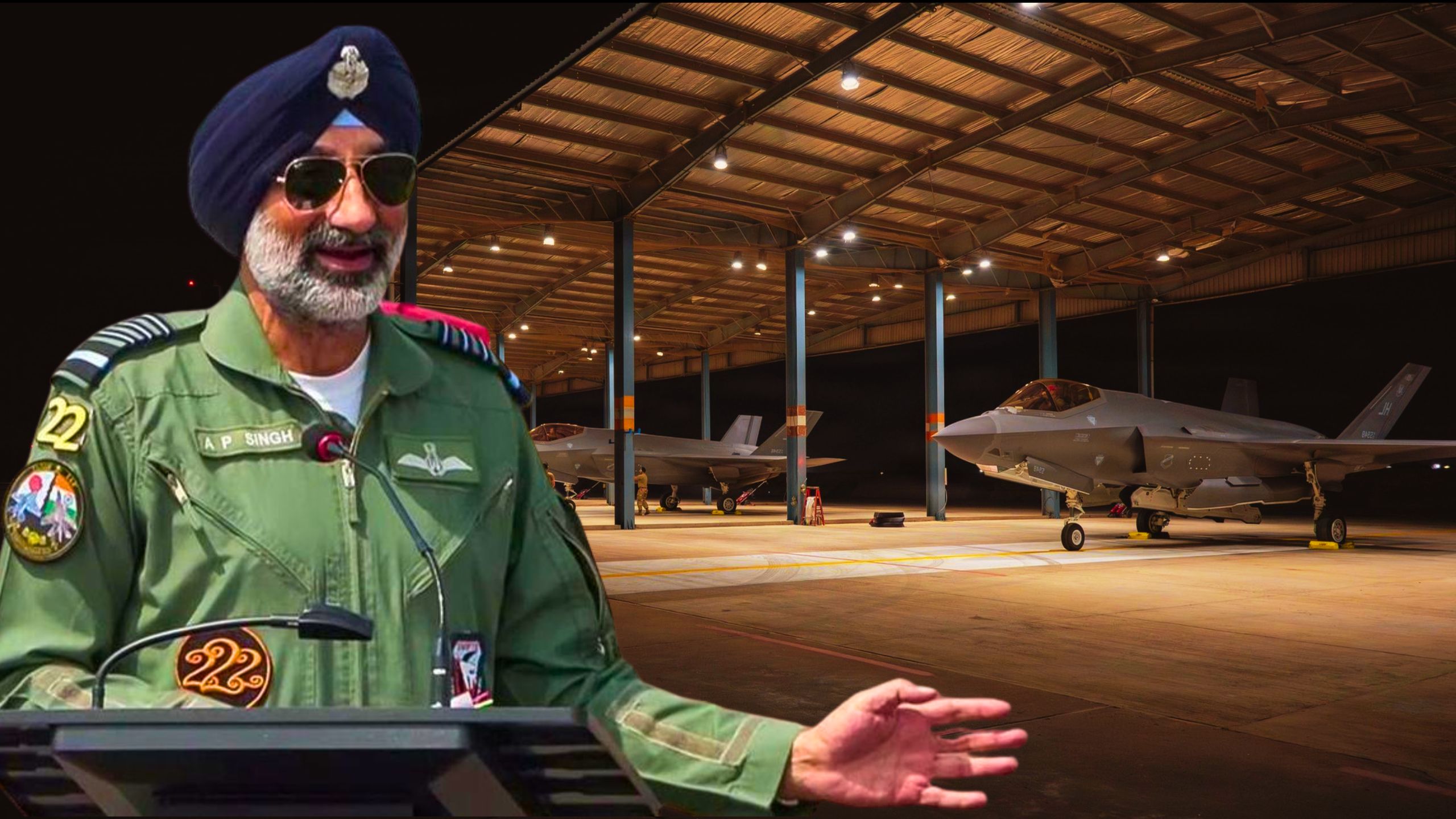
“Your people don’t even let us go near the aircraft, and you are talking about selling it to us.”
Air Chief Marshal AP Singh’s crack at the Americans in Jodhpur on Saturday drew the expected laughs. Sitting alongside US Pacific Air Forces commander General Kevin Schneider at the conclusion of Exercise Tarang Shakti 2026, the Indian Air Force chief was responding to the inevitable question about whether the United States had formally offered India the F-35, six of which had been fielded at the ongoing multilateral exercise.
It had not, Singh clarified. The Americans, he said, had not even allowed Indian personnel near the aircraft, forget into the F-35 cockpit, though IAF fighters had been permitted to fly in close formation with them.
It was tongue-in-cheek, typical to the outgoing IAF chief’s media demeanour. It was also an unexpectedly neat summary of perhaps the strangest fighter courtship in Indian military aviation.
Because, as Livefist has reported before, the F-35 has been coming to India for more than twenty years without ever actually arriving.
Six F-35As deploying to Jodhpur for Tarang Shakti is emphatically not regular programming. This was the aircraft’s first participation in an exercise on Indian soil, with more than 200 American personnel supporting the deployment. For an aircraft protected by some of the tightest security protocols in the US military inventory, six jets operating from an Indian fighter base and training alongside the IAF is significant by any measure.

And yet, as Singh’s joke demonstrated, proximity is not intimacy.
Livefist first reported on Indian briefings about the F-35 nearly two decades ago. The story began in 2005, when the Indian Navy received a preliminary presentation on the carrier-capable F-35C. By 2007, Lockheed Martin had briefed the IAF on the F-35A. But, of course, there was a catch.
Lockheed Martin was then trying to sell India 126 F-16s in the M-MRCA competition, and the F-35 was effectively being dangled as the glittering destination at the end of an American fighter pathway. Buy into the F-16 ecosystem now, the pitch broadly suggested, and the F-35 could logically follow later.
More presentations followed in 2008. In 2010, responding to an Indian Navy request for information, Lockheed Martin pitched both the F-35B jump-jet and carrier-launched F-35C, even studying whether the latter could operate from the ski-jump equipped INS Vikramaditya.
In 2011, then Pentagon acquisition chief Ashton Carter went further, publicly saying India was welcome to participate in the F-35 programme and later acquire the aircraft. As the decades have shown, India consistently chose otherwise.
That is an important part of the story often lost in the breathless question of whether America will “give” India the F-35. India has had repeated opportunities to enter the American combat aircraft ecosystem and has repeatedly declined them. Especially considering that India has acquired virtually every other type of American military aircraft: transport (C-130J and C-17), maritime reconnaissance (P-8I), attack helicopters (AH-64E Apache), heavy rotorcraft (CH-47F Chinook), anti-submarine rotorcraft (MH-60R) and, in the near future, 31 MQ-9B Sea/SkyGuardian drones.
The F-16 lost the infamous M-MRCA contest. The F/A-18 Super Hornet lost that competition too, and later lost the Indian Navy carrier fighter contest to the Rafale Marine. Lockheed Martin subsequently reinvented its India-specific F-16 proposal as the F-21. Boeing brought the F-15EX into the conversation.
But India still did not bite, a “consistency” based on a somewhat ironically inconsistent doctrine on acquisitions, which is to say don’t bet your frontline jets on American whims, but it’s okay if all the rest of your fleet types is.
In 2012, the Rafale won the M-MRCA competition. India eventually bought 36 Rafales directly from France and has since moved decisively deeper into that ecosystem, and is now all set to acquire 114 more, centred around a complex ‘Make in India’ piece.
The F-35 nevertheless kept hovering in the background.
In February 2025, President Donald Trump finally did what no American president had done before, declaring alongside Prime Minister Narendra Modi that the United States was “paving the way to ultimately provide India the F-35 stealth fighters.”
Even then, the wording mattered. “Ultimately.”

Twenty months later, the IAF chief says there is still no formal offer.
The F-35 therefore remains what it has been for two decades: a spectacular prize permanently visible at the end of the rainbow, but one India has never demonstrated serious institutional enthusiasm for pursuing.
The difference today is that the IAF’s circumstances have changed dramatically. At his annual press conference only days before Tarang Shakti, Singh was unusually explicit about the fifth-generation gap.
“We have to fill in the gap. If the other side is getting the 5th generation across, we need to look at some 5th generation,” he said.
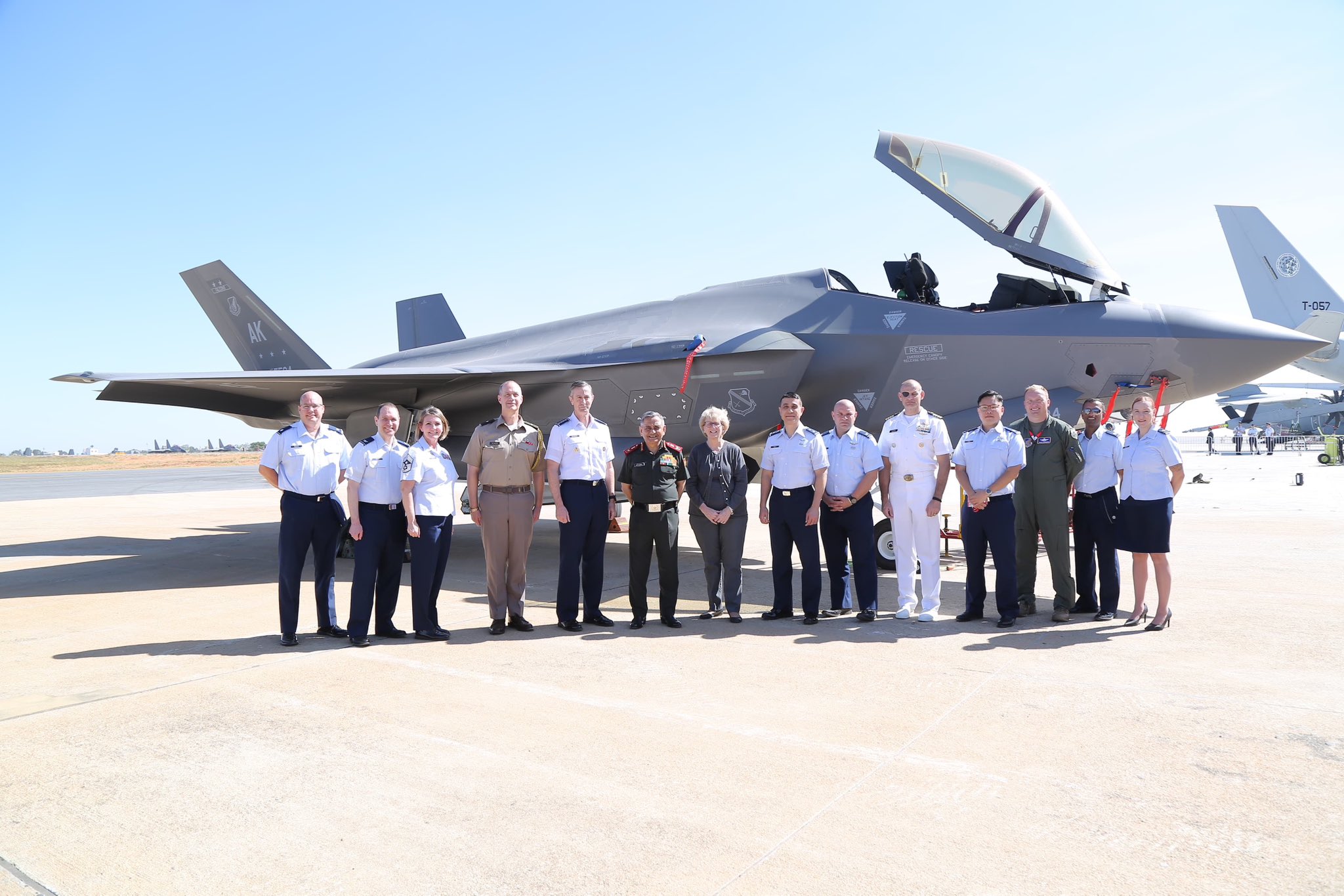
He went further: “For the future, we need to think ahead. We need to bring in a fifth-generation aircraft quickly. We have to push the AMCA programme. And if there are delays in it, we need to take some other decisions.”
Those are consequential words.
India’s longstanding, and choiceless, answer to the stealth fighter gap has not simply been to acquire a foreign stealth fighter. It has invested heavily in sophisticated ground and airborne sensors, electronic warfare, long-range weapons and layered air defence, including the S-400, partly to reduce the operational advantage enjoyed by low-observable aircraft. A part of this was on display during last year’s Op Sindoor exchange.
But denaturing the enemy’s stealth advantage is not the same thing as possessing stealth yourself. That reality was articulated in no uncertain terms by the IAF Chief at his press conference. And that is where the IAF’s dilemma becomes acute.
The homegrown AMCA is years away, with a targeted first flight in September 2028. The Tejas Mk2 is expected to fly next year. The Tejas Mk1A programme is already running years behind its original delivery schedule. The IAF has fallen to 29 fighter squadrons, and Singh says it needs 36 to 40 new fighters every year merely to begin repairing its force structure.
Nobody disagrees that something has to give.
Which brings the Russian Su-57 Felon back into the room.
Russia has formally offered the Felon, something Singh confirmed again in Jodhpur. Moscow is pitching aggressively, including production and technology cooperation in India. More importantly, unlike the F-35, the Su-57 exists as an immediately negotiable proposition.
But the irony is enormous, and the Su-57 would be by all accounts a difficult pill to swallow.
India walked out of the Russian FGFA programme in 2018 after spending $295 million on its preliminary design phase. The IAF had deep reservations about what Russia was offering, including stealth performance, engine maturity, cost and access to technology. India left in considerable frustration, choosing ultimately to place its fifth-generation faith in the indigenous AMCA.
Eight years later, the descendant of the aircraft India walked away from is back as perhaps the most accessible answer to the gap the IAF now admits it must fill. That confounding irony isn’t lost on the system. But when it comes to India and Russia, such ironies are easily blurred.

The Su-57 has hardly covered itself in glory during the Russia-Ukraine war. Its operational exposure has been limited, and Moscow has understandably been cautious about risking its tiny fleet in heavily defended Ukrainian airspace. But those limitations may matter less than the brutal arithmetic confronting New Delhi.
And, the Russians are aware that the Indian system loves precedent.
The Su-30MKI itself entered Indian service amid enormous geopolitical and industrial compulsions in the 1990s, when post-Soviet Russia and its defence industry were in deep distress. What began as an unusual purchase of a large Russian heavy fighter ultimately became the backbone of Indian air power, with nearly 300 aircraft acquired and the type transformed through Indian, Russian, French and Israeli systems into something substantially different from the aircraft originally offered.
When it comes to Indian defence decisions, history never repeats cleanly. The IAF under Air Chief Marshal AP Singh has been notably assertive about what it needs, about delays it considers unacceptable and about the consequences of waiting indefinitely for promised capability. But time is now the commodity it has least of, especially since the gap in combat mass with China is growing by the week.
China already fields the J-20 in substantial numbers and continues developing the J-35 family. Pakistan’s expected fifth-generation trajectory adds another dimension. India’s AMCA remains the long-term answer, but the operational problem exists now.
Which leaves the IAF confronting a deeply uncomfortable menu.
The F-35 remains tantalisingly close but politically, technologically and procedurally distant. The Su-57 is available, but is seen as a suboptimal fighter that carries the baggage of a program India already abandoned once. The AMCA is the fighter India actually wants, but cannot have for years.
In Jodhpur this weekend, six F-35s sat on Indian soil while the chief of the Indian Air Force joked that his people were barely allowed near them. Everyone laughed.
The joke was funny because, after twenty years, almost nothing about the F-35’s relationship with India has really changed.
What has changed is India’s ability to keep waiting.