
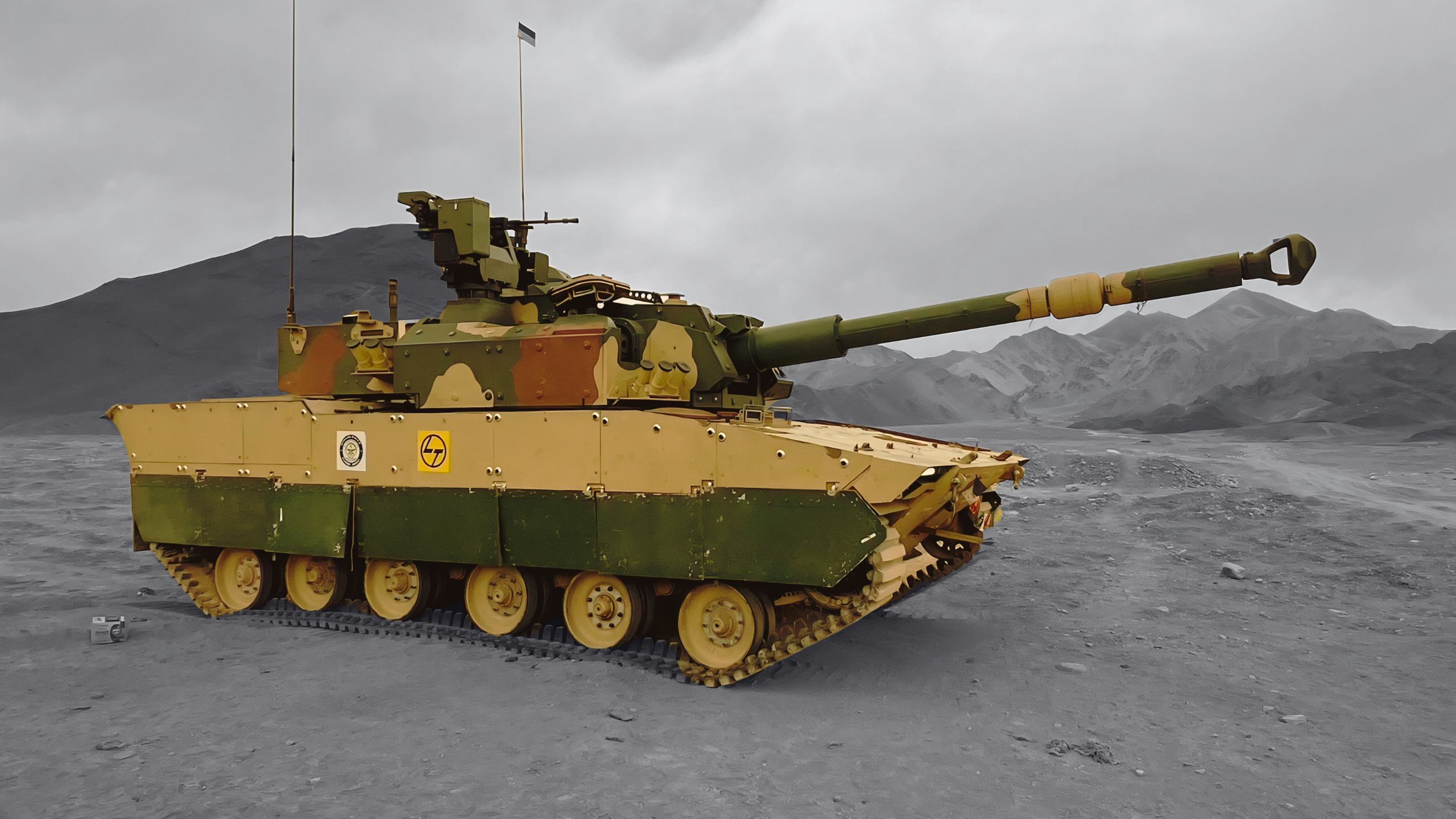
In a significant reveal on India’s homegrown high-altitude light tank project, Defence Secretary Rajesh Kumar Singh has confirmed that the Indian Army’s initial order of 59 for the DRDO-Larsen & Toubro (L&T) Zorawar light tank is being split.
The decision comes after the Army introduced elevated operational requirements midway through the development cycle, raising concerns among defence analysts that the critical armored platform risks falling into the classic “shifting goalposts” trap that famously plagued the Arjun Main Battle Tank (MBT).
Speaking at the NDTV Defence Summit in a wide-ranging interaction with NDTV Managing Editor and Livefist founder Shiv Aroor and NDTV’s Vishnu Som, Singh detailed the delicate balancing act underway between the Ministry of Defence, the Indian Army, and development partner L&T.
Addressing the pace and progression of the Zorawar program, Singh explained that the project represents a classic case of evolving requirements impacting development timelines, but affirmed that a practical compromise had been reached to keep industrial momentum alive.
“It’s an example of what I mentioned that you start with a certain level of requirements then somewhere down the line you want something more which delays the induction process,” he said.
To prevent the developmental partner from losing momentum while accommodating the Army’s demand for enhanced survivability and features, the Ministry of Defence intervened to strike a phased approach.
“So we’ve tried to find a middle way between the… as I mentioned my role now gives me the chance to mediate some of these differences,” Singh revealed. “So what we are hoping to do is do an initial Mark 1 which has a certain level of capability, and the balance… I think the initial order was meant to be 59, so about 18 to start with with a slightly lower level of protection and the balance at a higher level…”
Emphasizing the importance of sustaining private sector confidence in indigenous defence manufacturing, Singh added: “…get the induction started so that the development partner which is L&T as you mentioned does not lose heart and stop working on this. So I think the Army has pretty much agreed to that so we hope to take this forward in that manner.”

The Defence Secretary also pointed out that the broader light tank requirement is simultaneously being pursued under a government-funded competitive pathway.
“The light tank otherwise is under a Make 1 program which is funded by the government. In that program I think TASL (Tata Advanced Systems Ltd) and Mahindra are the winners and they will be developing prototypes themselves. But for this particular development route case, L&T will be getting an initial order at least hopefully fairly soon,” Singh confirmed.
Project Zorawar was conceived in the immediate aftermath of the May 2020 standoff with China in Eastern Ladakh. As the People’s Liberation Army (PLA) deployed its lightweight, highly agile Type 15 (ZTQ-15) tanks along the Line of Actual Control (LAC), the Indian Army found itself forced to airlift heavy, 40-50-tonne T-72 and T-90 Main Battle Tanks into high-altitude plateaus over 14,000 feet. While the T-72s and T-90s provided sheer firepower, their immense weight, reduced engine efficiency in rarefied air, and physical bulk limited their operational agility across narrow mountain passes and riverine valleys.
In April 2021, the Indian Army issued a request for information (RFI) for 354 light tanks weighing under 25 tonnes, capable of high-altitude deployment, amphibious movement, and air-transportability aboard the IAF’s C-17 Globemaster III aircraft.
To meet the urgent operational requirement, DRDO’s Combat Vehicles Research & Development Establishment (CVRDE) partnered with private defence giant Larsen & Toubro (L&T) to rapidly design and roll out a prototype. Armed with a John Cockerill 105mm high-pressure rifled main gun, an autoloader, integrated anti-tank guided missiles (ATGMs), loitering munition capability, and a Cummins engine mated to a RENK transmission, the first prototype rolled out in early 2024 in record time.
Preliminary firing and mobility trials took place in Gujarat, followed by deployment to Nyoma in Ladakh for high-altitude firing and mobility validation at heights exceeding 14,000 feet.
The Indian Army’s total projected requirement stands at 354 light tanks, estimated at an overall program value of approximately Rs 17,500 to Rs 20,000 crore. The acquisition strategy was initially divided into two parallel tracks:
- Development Route (DRDO & L&T): An initial tranche of 59 tanks was earmarked for L&T to quickly induct early operational units.
- Make-I Route (Competitive indigenisation): The remaining 295 tanks were slated for a competitive, government-funded Make-I project under the Defence Acquisition Procedure (DAP) 2020, where the MoD funds up to 70% of prototype development costs.
In a major parallel development under the Make-I track, Tata Advanced Systems Ltd (TASL) emerged as the L1 bidder, with Mahindra Defence Systems occupying the L2 position. Both private giants have been invited to build two operational prototypes each within a designated 130-week timeframe. Once tested and field-validated, the massive production order for the balance 295 tanks will be split between them.
However, L&T’s original tranche of 59 tanks under the fast-track development route has now been truncated into two sub-variants: an initial 18 units of Zorawar Mark 1 (featuring the existing protection configuration) and a subsequent 41 units of Zorawar Mark 2 incorporating the Army’s revised requirements for increased armor and active protection systems.
The decision to truncate L&T’s initial manufacturing batch to just 18 tanks while demanding higher protection standards for the remaining order has triggered intense debates among military strategists and defence analysts. To many, the current dynamic bears an eerie resemblance to the troubled history of the Arjun Main Battle Tank.
During the Arjun’s development, the Army repeatedly revised its Qualitative Requirements (GSQRs) adding heavier modular armor, complex electronics, and specialised subsystems. While each individual request aimed to make the platform more lethal and survivable, the cumulative effect was disastrous: the tank’s weight ballooned from an intended 40 tonnes to over 62 tonnes, rendering it too heavy for standard Army bridges and rail infrastructure along the western border, which severely restricted its operational utility and drastically curtailed serial production orders.
Defence experts warn that forcing similar late-stage modifications onto the Zorawar threatens the core philosophy of the entire platform: light weight and transportability.
The Zorawar’s strict weight ceiling of 25 tonnes is its defining operational asset. It is precisely what allows two tanks to be airlifted inside a single C-17, cross mountain bridges, and navigate high-altitude terrain. Demanding significantly higher armor protection on a 25-tonne chassis inevitably pushes the weight upwards. If weight increases, the tank requires a larger engine, modified suspension, and heavier drive trains, setting off a cascade of redesign cycles that threaten to push serial induction further down the line toward 2028-29.
Furthermore, analysts highlight the severe financial and operational risk posed to private sector development partners. L&T invested substantial internal capital, engineering resources, and production infrastructure at its Hazira facility to deliver the prototype in under two years. Truncating the immediate production commitment to just 18 units forces the manufacturer to absorb significant overheads without the cost-efficiencies of a full serial production line.
While the Defence Secretary’s pragmatic intervention ensures that L&T receives an initial contract to keep the production line alive, the broader warning from analysts and even several veteran Armoured Corps officers remains clear: if the Indian Army continually shifts goalposts in pursuit of an ideal tank, it risks repeating historical mistakes, leaving frontline units waiting for capabilities that remain perpetually trapped in developmental loops.
Proponents defending the Indian Army’s changing requirements contend that operational requirements can never remain static when the contemporary threat matrix along the Line of Actual Control (and in tank warfare per se) is evolving at an unprecedented pace. From their perspective, demanding enhanced armor protection, STANAG Level 6 ballistic resistance, and integrated Active Protection Systems (APS) is not an exercise in administrative perfectionism, but a non-negotiable imperative driven by real-world combat lessons from recent global conflicts, where top-attack anti-tank guided missiles, loitering munitions, and swarm drones have dramatically heightened tank vulnerability. They argue that inducting an under-protected platform simply to meet an arbitrary developmental timeline risks putting armored crews at unacceptable risk in high-altitude battlespaces. From this standpoint, forcing a designer like L&T to engineer modular, higher-level protection within a strict weight ceiling is precisely the kind of technological challenge an indigenous defence ecosystem must conquer if it aims to deliver world-class combat platforms capable of surviving tomorrow’s battlefield.