
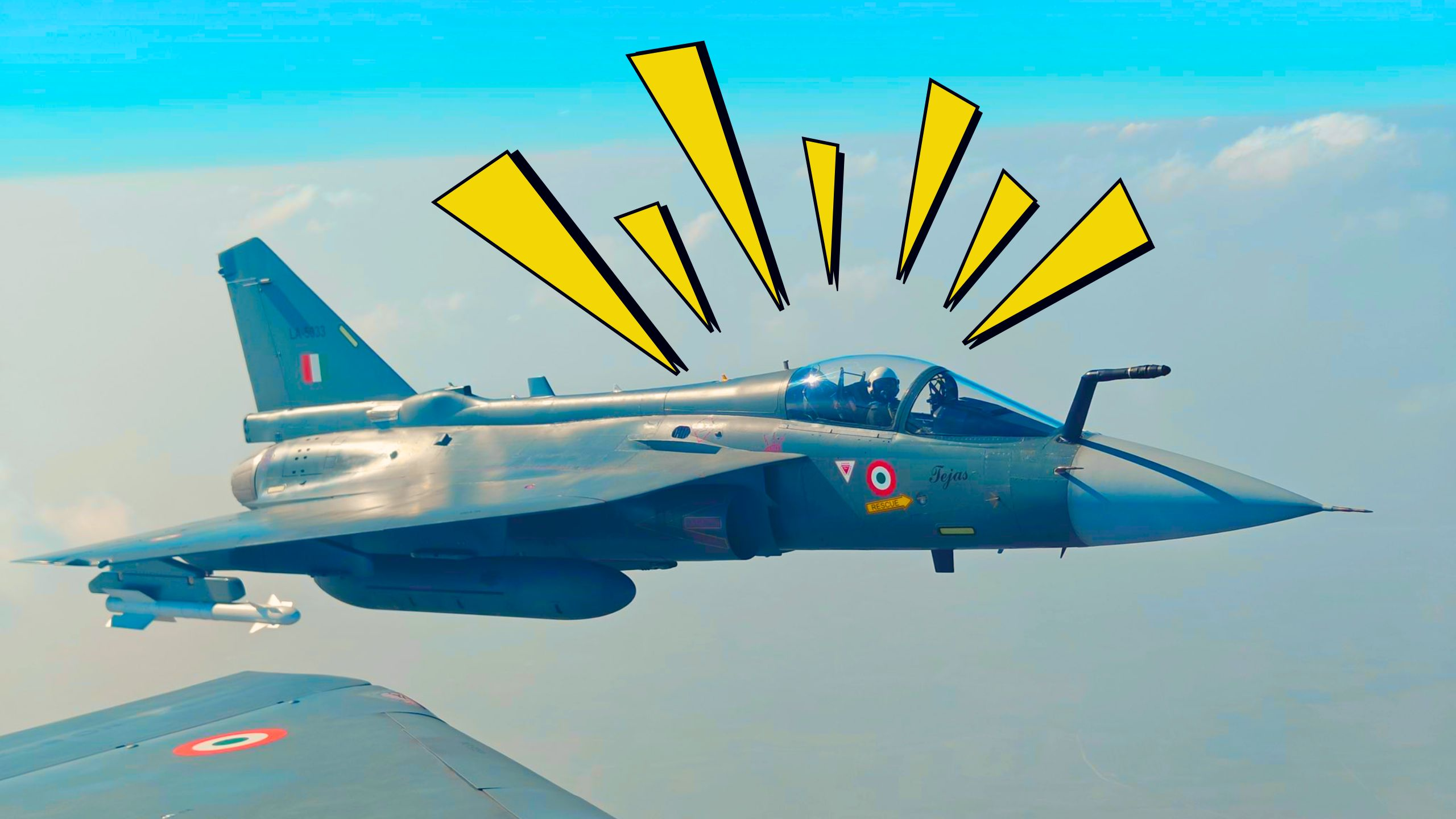
In a second ‘clarification’ in two days, Hindustan Aeronautics Limited (HAL) has responded to fresh reports that have indicated further delays in deliveries of LCA Tejas Mk1A fighters. As part of a clear effort to quell growing concerns in the Indian Air Force (IAF), HAL has issued an unusually comprehensive status update.
The statement comes at a critical juncture for India’s premier indigenous fighter program, which has been under intense scrutiny due to prolonged delivery slips.
HAL has confirmed that five aircraft are now “fully ready” for delivery, featuring the major contracted capabilities and specifications required by the IAF. Beyond these, an additional nine aircraft have been built and have already completed flight tests. However, these nine airframes remain grounded, awaiting the arrival of F404-IN20 turbofan engines from the American manufacturer GE Aerospace.
“Upon receipt of engines from GE, these aircraft will be made ready for delivery,” the state-run corporation stated, signaling that the production bottleneck continues to be tied to, at least partly, the global aerospace supply chain.
Strangely, HAL indicates that the five “fully ready” aircraft incorporate “major contracted capabilities”, a contradiction, since this indicates that the airframes don’t incorporate ALL contracted capabilities. This may be the heart of the latest delay and the IAF’s continued refusal to accept the aircraft. HAL’s statement tellingly states, “All design and development issues identified are being addressed in an expedited manner.”
The Mk1A is the most sophisticated version of the Tejas, a 4.5-generation upgrade of the original LCA Mk1. It is designed to be a light ‘swing-role’ backbone of the IAF, filling the gap left by retiring legacy platforms. Key enhancements over the Mk1 include an Active Electronically Scanned Array (AESA) radar for superior detection, an advanced Electronic Warfare (EW) suite, a Mid-Air Refueling (MAR) probe, and the ability to fire long-range Beyond Visual Range (BVR) missiles like the indigenous Astra.

The financial stakes of this program are large by the standards of procuring homegrown equipment. In February 2021, the Ministry of Defence signed a ₹48,000 crore contract for 83 Mk1A jets (73 fighters and 10 trainers). Building on this momentum, the government cleared an additional order for 97 more aircraft in September 2024, valued at over ₹62,370 crore. Combined, the Tejas Mk1A program represents a commitment exceeding ₹1.1 lakh crore, cementing its status as the largest Make in India defence project to date.
The journey of the Mk1A has been a race against time that started behind the curve. While the first delivery was originally slated for February 2024, the timeline has shifted repeatedly.
-
2021: The ₹48,000 crore contract is signed, with a 36-month delivery window.
-
2022–2023: Global supply chains, still reeling from the pandemic and geopolitical shifts, begin to slow the delivery of critical components.
-
March 2024: The first prototype of the Mk1A takes its maiden flight, but series production lags.
-
Late 2024 – Early 2025: Delays in GE’s F404 engine production become the primary obstacle. GE reportedly faced issues with its own sub-vendors, pushing back the delivery of the 99 engines ordered in 2021.
-
February 2025: Current status reveals only five engines have been delivered to date.
HAL’s latest statement, in response to a news report from agency ANI, strikes an optimistic tone, noting that the supply position from GE is now “positive” and that future outlooks align with HAL’s internal production schedules. The company maintains it will meet its financial guidance for the current fiscal year, despite the hardware delays.
The technical and logistical delays reached a boiling point last year, leading to a rare public display of friction between the IAF leadership and HAL. At the Aero India show last February, Chief of the Air Staff, Air Chief Marshal A.P. Singh upbraided HAL for its inability to stick to the delivery schedule. The Air Chief’s frustration was palpable, he emphasized that “the industry must take the lead in finding solutions” to ramp up production.
This scolding was not merely about missed dates but about national security. The Air Force Chief made it clear that while the IAF was fully committed to indigenisation, it could not afford to let its operational edge blunt due to production inefficiencies. The bluntness of the critique served as a wake-up call, forcing HAL to speed up the activation of a third production line in Nashik to augment the existing lines in Bengaluru.
Why is the Tejas Mk1A needed so urgently? The answer lies in the IAF’s legacy plaint: its squadron crunch. The IAF is sanctioned to have 42 fighter squadrons to effectively manage a “two-front” threat from China and Pakistan. However, due to the phased retirement of the MiG-21, MiG-23, and MiG-27 fleets, the strength has plummeted to approximately 30–31 squadrons, perhaps less.
Each squadron consists of about 18 to 20 aircraft. The delay of even one year in the Tejas program means the IAF is forced to fly legacy aircraft like the Jaguar and MiG-29 for longer than intended, increasing maintenance costs and safety risks. The Tejas Mk1A is the only viable, mass-produced indigenous solution capable of arresting this decline in the short term. Without these 180 aircraft (83 + 97), the IAF’s ability to maintain a credible deterrent in the region will be severely compromised.
HAL’s clarification is an attempt to reassure the IAF and the Ministry of Defence that the project is back on track. With five jets ready and another nine airframes awaiting engines, the physical production of the aircraft has reached a cadence that can finally match the IAF’s requirements provided the external supply of engines remains steady. The recent thaw in India-US relations, coupled with the attendant resumption of pace in separate defence supplies like six additional Boeing P-8I jets to the Indian Navy, should provide predictability on this front.
The next few months will be crucial. As the five ready aircraft are inducted, the IAF will begin operationalising its first Mk1A squadron. For HAL, the challenge is no longer just building a fighter jet, but proving it can manage a global supply chain to deliver on the promises made to a hungry IAF.