
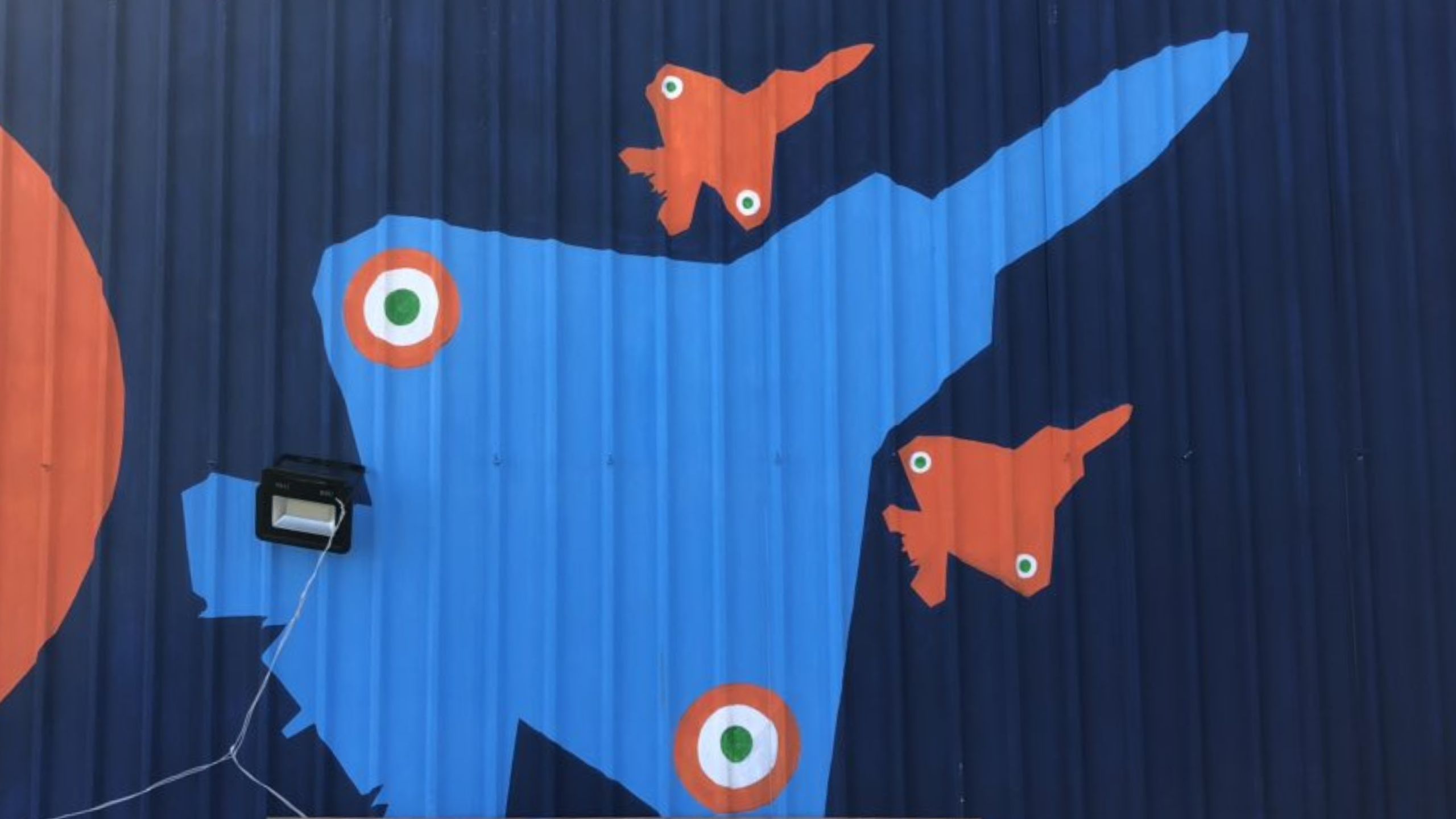
In a watershed moment for Indian military aerospace, the Ministry of Defence has formally shortlisted three private sector titans: Tata Advanced Systems Limited (TASL), Larsen & Toubro (L&T), and Bharat Forge to compete to lead the development and manufacturing of the country’s fifth-generation stealth fighter, AMCA (short for Advanced Medium Combat Aircraft).
The most striking headline is the name missing from the list: Hindustan Aeronautics Limited (HAL). For the first time in the history of indigenous combat aviation, the state-run monolith has been excluded from the cockpit of a frontline fighter program.
The development was first reported today in Indian newspapers Economic Times and Hindustan Times.
In a statement, HAL said, “Various media reports regarding the Advanced Medium Combat Aircraft (AMCA) programme have come to HAL’s attention. HAL has not received any official communication in this regard and, therefore, is not in a position to comment on these reports at this stage. HAL is committed to keeping all stakeholders fully informed of all developments.”
The decision marks a decisive end to HAL’s decades-long monopoly and signals a fundamental shift in New Delhi’s strategy. By placing the AMCA largely in private hands (the winning firm will still work with the stare-governed Aeronautical Development Agency), the government is betting on a more competitive, efficient, and technologically agile industrial base to secure India’s skies.

The AMCA program had originally been structured under a unique Strategic Partnership model designed to foster public-private synergy, where one partner would be HAL. But with HAL now dropped from the race, the shortlisted firms are now entering a high-stakes race to become the ‘Industry Partner’ that will work alongside ADA, the DRDO’s aviation design arm.
As Livefist understands it, the winner of this contest will be tasked with:
-
Prototype Development: Co-developing five AMCA prototypes and one structural test specimen.
-
Manufacturing Ecosystem: Establishing a dedicated, state-of-the-art production line capable of “series production” independently.
-
Time-Bound Execution: Completing the entire development cycle—from prototyping to flight testing and certification—within a strict eight-year window.

With an indicative budget of ₹15,000 crore for the prototype phase alone, the stakes are astronomical. The winner will eventually oversee the production of at least 120 aircraft, a contract that could be worth hundreds of billions of dollars over two decades, with the first aircraft coming online roughly a decade from now.
HAL’s exclusion from the contest is not merely a lost contract, but a structural demotion. Historically, HAL has been the default integrator for every Indian fighter, from the Marut to the Tejas. The government’s decision to disqualify HAL, reportedly due to a clause that penalised firms with massive, undelivered order books (HAL’s ratio is nearly 8:1 relative to turnover) is a clear red card for the PSU’s chronic delays.
In its statement, HAL also said, “HAL would like to reiterate that it has a robust confirmed order book, providing strong revenue visibility, and a healthy production and execution pipeline extending up to 2032. HAL is simultaneously advancing multiple strategic programmes, including the Indian Multi Role Helicopter (IMRH), LCA Mk2, and Combat Air Teaming System (CATS), which will further strengthen its technological capabilities and long-term growth prospects. These programmes are expected to enter production post-2032. HAL is also diversifying its portfolio in the civil aviation segment with platforms such as the Dhruv NG, Hindustan 228 and the SJ 100, which will enhance revenue and provide sustainable growth in the future. HAL has strong fundamentals and is committed to delivering sustained year-on-year growth through consistent performance.”
This shift mirrors the Tata-Airbus C295 partnership, which established India’s first private military aircraft assembly line in Vadodara. That project proved the private sector could handle complex aerospace integration with international partners. In that program too, HAL had been specifically kept out. By keeping HAL out of the AMCA effort, the government is making it clear that “Atmanirbhar Bharat” (Self-Reliant India) does not mean a “HAL-reliant India.”
The seeds of this exclusion were sown years ago. In 2020, Livefist first reported that HAL was spearheading a plan to create a joint venture (JV) with a private firm and the DRDO to lead the AMCA. At the time, it seemed like a compromise to keep HAL at the helm while satisfying the private sector’s hunger for participation.
However, the plan collapsed under the weight of “workshare” anxieties. Industry insiders suggest that private giants like L&T were deeply skeptical of the JV model. They feared that HAL would retain the ‘high-value’ systems and decision-making power, leaving the private partner as little more than a glorified fabricator. The private sector demanded a level playing field where they could act as the Lead System Integrator (LSI). The MoD’s current shortlisting confirms that those concerns have been heard: the private sector is no longer just a junior partner, but a primary driver with actual skin in the final game.
The urgency to get the AMCA airborne has never been higher. India’s neighborhood is rapidly turning stealthy.
-
China: Has already deployed several squadrons of the J-20 and is testing the J-35 and even purported sixth-generation platforms.
-
Pakistan: Recent reports indicate Islamabad is in advanced talks to acquire the Chinese J-35 stealth fighter, which could fundamentally tip the balance of stealth air power in the subcontinent.
With the AMCA’s first flight not expected before 2028-2029 and induction only by 2035, India faces a risky ‘stealth gap’. The decision to move to the private sector could be seen as a desperate attempt to bypass the sluggishness that has plagued HAL-led projects like the Tejas LCA, even accounting for systemic failures, governmental delays and industrial inertia.
The new path carries significant risks. While Tata, L&T, and Bharat Forge have stellar reputations, none have ever built a fighter jet from scratch. The transition from components to platforms is a steep learning curve. If the private sector stumbles, India will have no fallback option, having already sidelined its only experienced aircraft manufacturer.
This brings us to the inevitable question of a stopgap acquisition. With the IAF’s squadron strength dwindling and the AMCA still a decade away, the pressure to buy an off-the-shelf stealth jet is mounting.
As Livefist has reported before, Russia has sensed this opening. Moscow has been increasingly vocal, offering the Su-57 to India with promises of deep technology transfer and joint production at existing Su-30MKI facilities. While New Delhi remains committed to the indigenous AMCA, the sheer speed of Chinese and Pakistani advancements may force a rethink.