
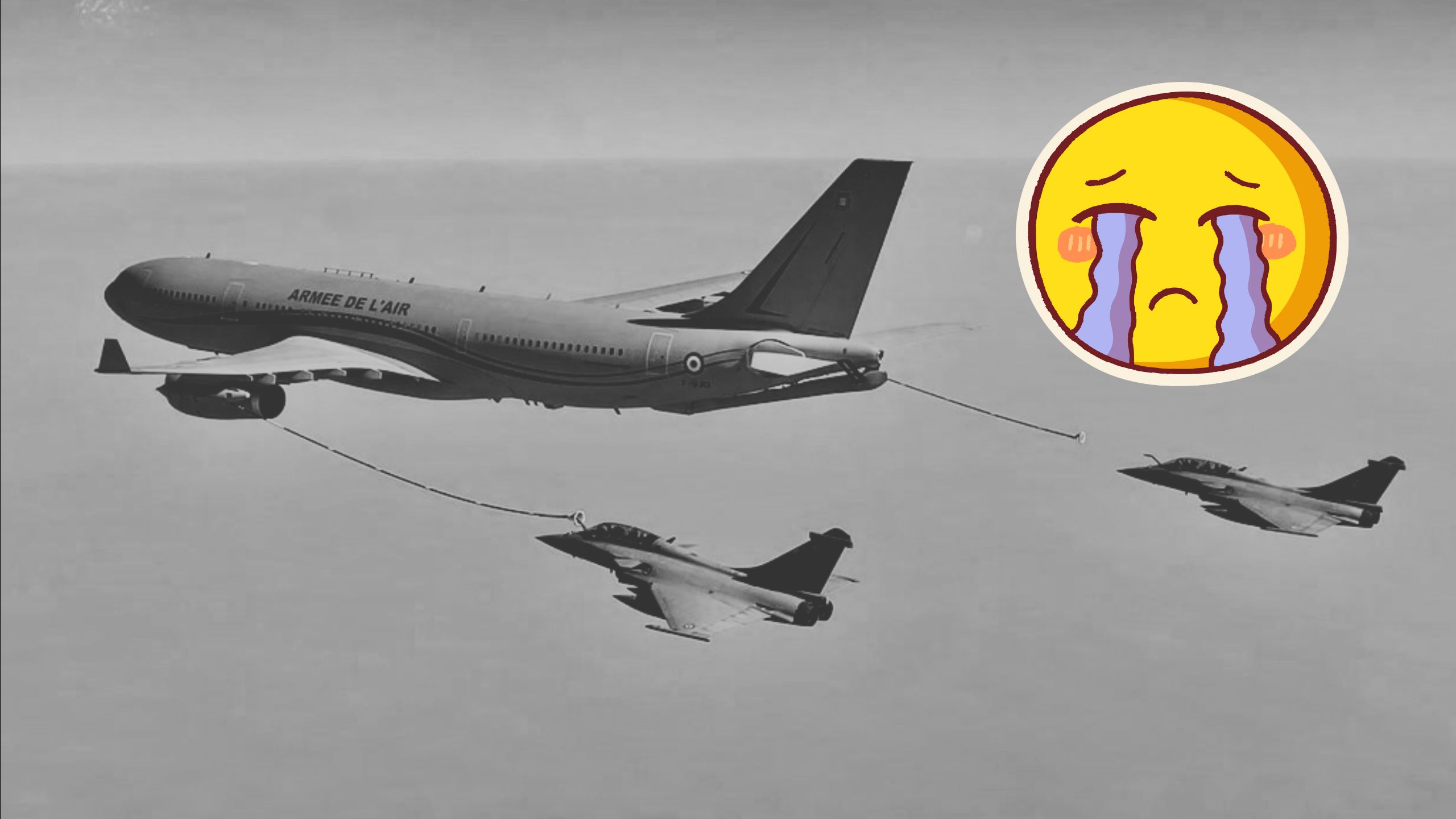
The Indian Air Force’s (IAF) two-decade quest for mid-air refueling tankers may finally be moving past the stage of perennial disappointment. For years, the lack of progress on this front became a symbol of the bureaucratic inertia and inter-ministerial inability to decide, often associated with major military acquisitions. However, the wait may be nearing an end as the Ministry of Defence (MoD) has begun 2026 by providing a pre-final push for a capability that has been on the IAF’s wishlist since the mid-2000s.
The MoD’s apex Defence Acquisition Council (DAC) has cleared a deal valued at approximately $900 million for six pre-owned Boeing 767 aircraft. These will be refurbished and converted into tankers by Israel Aerospace Industries (IAI) in partnership with Hindustan Aeronautics Limited (HAL). That’s if the deal closes. And in this procurement, the ‘if’ has two decades of uncertainty behind it.
In the latest episode of the Ctrl+Alt+Defence podcast, veteran defence journalist Vishnu Som and Livefist founder Shiv Aroor dissected this long-awaited move, reflecting on a career arc spent tracing the frustrations of a fruitless hunt.
A Quarter-Century of ‘Any Day Now’
To understand the significance of this potential deal on the horizon, one must look, if painfully, back at the timeline of the IAF’s refueling capability or lack thereof.
-
2001 to 2003: India ordered and quickly inducted six IL-78 MKI ‘Midas’ tankers from Uzbekistan. At the time, the pace was blistering. “Things moved fast,” Vishnu Som noted. “In March 2003… we inducted the first one. By 2004, all six were delivered.”
-
2006: Recognizing that six tankers were insufficient for the world’s fourth-largest air force, the IAF issued the first RFP for six more. This was the start of a 20-year drought.
-
2010: The Airbus A330 MRTT was selected, but the deal was killed by the Finance Ministry over cost concerns. “The Ministry of Defence proposes and the Finance Ministry disposes,” Shiv Aroor remarked, highlighting the systemic friction that has plagued the project.
-
2013 to 2016: A second RFP saw Airbus win again, only for history to repeat itself. Pricing once again became the stumbling block.
-
2018: A third RFP was floated, this time bringing in Boeing’s KC-46 Pegasus alongside the IL-78 and A330.
-
2025: Desperate for capability, the IAF signed a “stop-gap” lease with US-based Metria Management for Boeing KC-135 Stratotankers. These are aircraft flown by retired US personnel. The first of these leased aircraft are set to begin operating with the IAF in April.
“If we go into a war with China or Pakistan, you know what happens to these [leased] tankers? They fly home,” Vishnu Som warned. “This is just for training. When the balloon goes up, they disappear.”
The IAI-HAL Solution: Pragmatism Over Perfection
The newly approved deal reflects a shift toward even more pragmatism. Rather than chasing the high-cost, new-build Airbus A330 MRTT or the Boeing KC-46 (both of which have seen their own share of procurement drama in Europe and the US) India has opted for the pre-owned conversion route.
Under this deal, six used Boeing 767s will be sourced from the commercial market. IAI, a global leader in aircraft conversions, will work with HAL to transform these civilian haulers into multi-mission tankers. IAI has committed to 30% local manufacturing, focusing on the refueling modules.
“Six used Boeing 767s will be acquired… in a $900 million deal,” Som explained. “The air-to-air refueling system is not an extensive system… it’s a kind of a module.”
While some may scoff at the idea of “second-hand” aircraft for a frontline role, the hosts argue the logic is sound. The IAF needs a “flying gas tank” that works, not necessarily a platform with a zero-hour odometer. With the IL-78 fleet suffering from abysmal serviceability (publicly cited at less than 50%) the 767s offer a reliable, Western-standard alternative.
The Strategic Imperative
Why the “goosebumps” over six tankers? As Shiv Aroor put it, defence procurement in India often feels like a “nightmare.” But the requirement is anything but academic. In an era where India’s “theatre of interest” extends from the Malacca Strait to the Gulf of Aden, and where the threat along the Line of Actual Control (LAC) remains “live,” endurance is everything.
“People will be saying, ‘Why do you even need so many refuelers?'” Aroor posited. The answer lies in force multiplication. Without tankers, India’s high-end assets like the Rafale and Su-30 MKI are tethered to their bases. Even more critically, India’s “eyes in the sky” (the Phalcon AWACS and Netra AEW&C) require constant loitering capability.
“The Netra can fly for about 4 to 5 hours,” Som estimated. “If you’re in a war-type situation, you want these planes to be deployed for a longer mission. What do you do? You refuel it air-to-air.”
Memories from the ‘Glass Nose’
The podcast took a personal turn as both journalists recounted their rare experiences inside these massive machines. Som recalled flying in an IAF IL-78 during the Red Flag exercises at Nellis Air Force Base, peering through the “glass nose” as Sukhois hooked up for fuel. He also described the nerve-wracking precision of US Air Force refueling in Hawaii.
“The boom comes and it locks on just above your head… I saw one pilot, as he was passing me, showed me his hand trembling,” Som shared. “You need to be that rigid on the controls.”
Aroor recalled his first trip as a defence correspondent to Agra, where he found himself unexpectedly airborne in an IL-78 observer pod. “I saw a Jaguar which came and refueled, and then a Mirage 2000… they both peeled away like that as a grand display.”
For Aroor, the current deal is “poignant” because it marks the end of a 25-year cycle that began with the pride of a new capability and ended in the “theater of the absurd.”
Conclusion: Capability First
The MoD’s decision to move forward with a “sole bidder” (IAI-HAL) is also a sign of maturing procurement rules. Following the legacy of former Defence Minister Manohar Parrikar, the government no longer views a single-bidder scenario as an automatic red flag for corruption.
“There is now perhaps a realization… that a sole bidder doesn’t mean it’s corrupt,” Som noted. “It has to be capability first. It’s just common sense.”
As the IAF prepares to sign the deal by March 2026, the message is clear. The quest for tankers was never about a “fantasy birthday list.” It was about ensuring that when the next crisis hits, India’s air power isn’t left running on empty.
The 767s may be second-hand, but for an Air Force that has waited literally since 2006, they are a first-rate necessity. And won’t be arriving a moment too soon.