
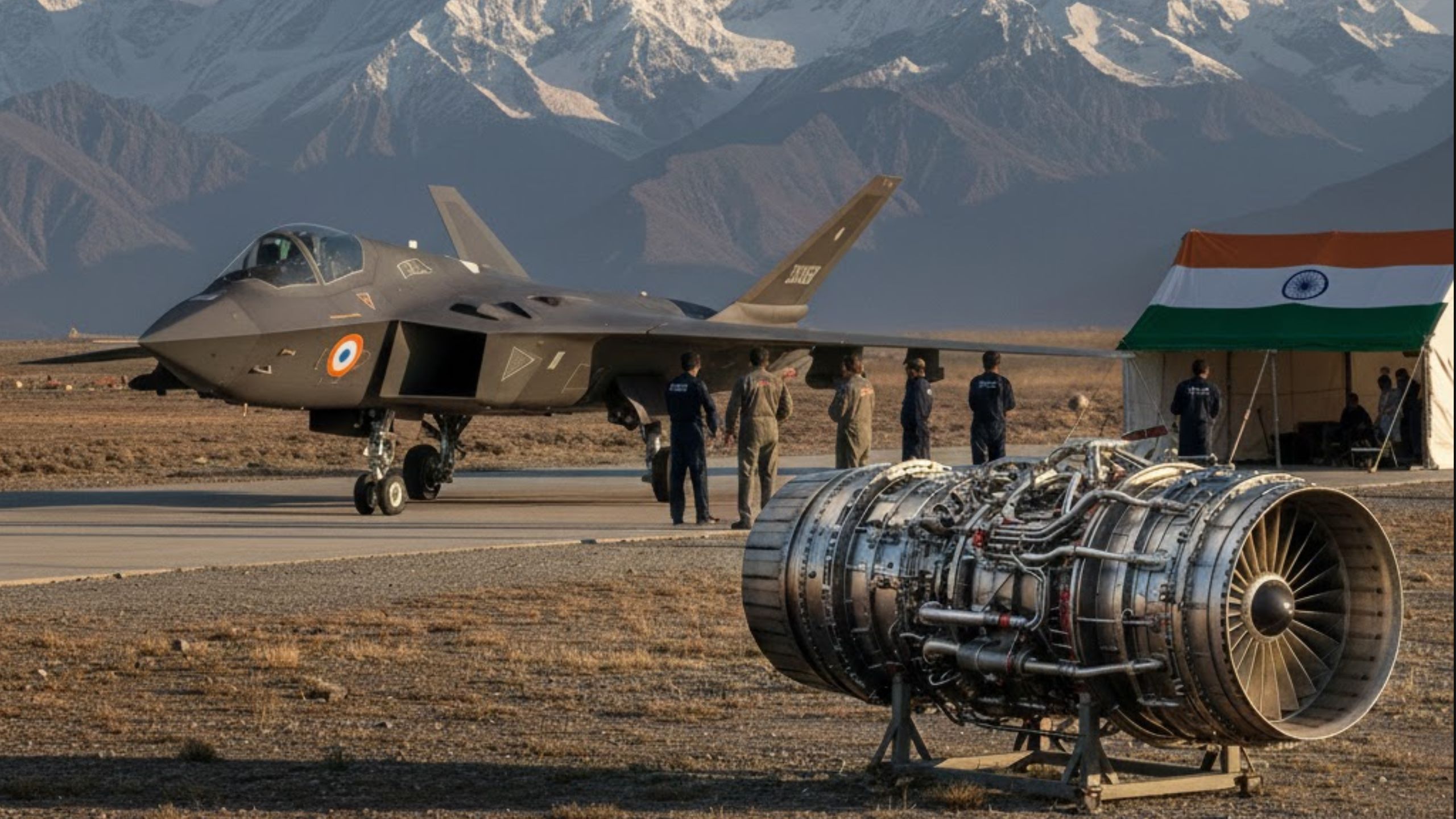
The French heart for India’s stealth. A Geopolitical engine change. Call it what you will, one of India’s most ground-breaking defence partnerships is afoot: a deal to jointly develop and build next generation aircraft engines to power India’s homegrown stealth fighters.
For decades, India has carried the unenviable title of the world’s largest importer of military aircraft, a status punctuated by a glaring Achilles’ heel: the inability to create a fighter engine of its own. Now, a potentially transformative partnership between India’s Defence Research and Development Organisation (DRDO) and France’s Safran is poised for final approval by India’s Cabinet Committee on Security (CCS). This deal, if cleared, would signal a strategic divorce from dependency, aiming to jointly develop the 110–120 kN powerplant for India’s fifth-generation Advanced Medium Combat Aircraft (AMCA).
To understand the weight of this moment, if it happens, one must look at the scars of the past. India’s quest for engine autonomy began in earnest with the Kaveri engine project in the late 1980s. Intended for the Tejas Light Combat Aircraft, the Kaveri eventually sputtered, failing to generate the necessary thrust for a modern fighter. While the project provided invaluable lessons in materials science and high-temperature testing, it left India fully dependent on foreign original equipment manufacturers (OEMs) specifically the American General Electric for its homegrown fighters.
The path to the current Safran deal was paved with the debris of previous attempts. Following the 2016 inter-governmental agreement for 36 Rafale jets, there was an intensive effort to convert the mandatory 50% offset commitments into a meaningful engine partnership. For years, those negotiations remained stuck in a limbo of technicalities, with Safran hesitant to share the crown jewels of engine technology, specifically the hot-engine core and single-crystal blade manufacturing, without a larger, long-term commitment.
The impending deal, estimated at approximately $7 billion, is fundamentally different from a traditional vendor-buyer relationship, at least on paper. The modalities represent a clean-sheet co-development. Unlike the proposed GE F414 deal, which involves a significant but capped transfer of technology (ToT) for an existing American design, the Safran-DRDO (specifically the Gas Turbine Research Establishment, GTRE) partnership envisions:
- 100% Transfer of Technology:** Total access to the most sensitive design codes and manufacturing processes.
- Joint Intellectual Property (IP): India will own the IP for the engine, ensuring that future modifications, upgrades, and even exports are entirely under New Delhi’s control.
- Modular Growth: A design that can scale from 110 kN to 140 kN, catering not just to the AMCA Mk2, but potentially to the Twin Engine Deck Based Fighter (TEDBF) for the Navy.
The Safran-GTRE partnership is part of a broader, more integrated French bet by India. Even as the engine deal nears the CCS, the Indian government, as Livefist has reported, is pushing ahead with the Multi-Role Fighter Aircraft (MRFA) program to buy and build 114 more Rafale fighters in India. By choosing Safran for the AMCA engine, India is ensuring a seamless technological continuum.
The strategy has been clear for a while now. France now straddles the final chapter of India’s fourth-generation requirements while simultaneously providing power for its fifth-generation next steps. This synergy potentially simplifies logistics, training, and maintenance by remaining with the French ecosystem, but more importantly, it will hopefully create a massive industrial aero-engine ecosystem within India. With Safran already establishing an M88 engine overhaul shop in Hyderabad, the foundations for a domestic aero-engine industry are being laid.
However, this Indo-French embrace comes at a delicate geopolitical juncture. As French President Emmanuel Macron prepares to visit India next month for the Global AI Summit, the Rafale and engine deals will undoubtedly be the centerpieces of his delegation’s agenda. But across the Atlantic, a temperamental Donald Trump is turning up the America First vigor even in the traditionally sober military trade conversation with India.
Trump has been vocal in his insistence that India buy more American weaponry to balance trade deficits. The fact that American giants like Boeing (with the F-15EX) and Lockheed Martin (with the F-21) competed fiercely for the IAF’s 114-jet deal, and that GE tech was the primary rival to Safran for the AMCA engine, makes India’s tilt toward Europe a ready provocation if Trump is looking for a new reason to throw a fit.
To a leader like Trump, who views trade through a lens of personal loyalty and “wins,” the technical logic of the Rafale to India makes little difference. India’s decision to choose French strategic autonomy over American ‘conditions-applied’ technology could be viewed as a slight. Yet, New Delhi appears to have calculated that the risk of a Trumpian fit is worth the reward of absolute control over its own flight path. Critics of the exorbitant Rafale deal (as well as the engine partnership) point to the ohvious irony of regarding another massive import and the welcoming of foreign technology as a step towards autonomy. Defenders argue that the IAF no longer has a choice.
The urgency of the Safran-GTRE partnership is underscored by recent history. India has faced significant anxiety over delays in the supply of GE F404 engines for the Tejas Mk1A (not a single one of 180 on order has been delivered yet), a bottleneck that has threatened to stall the IAF’s squadron recovery. This experience has been a sobering reminder that when you don’t own the engine, you don’t own the aircraft.
As the CCS prepares to greenlight this ₹30,000-crore leap of faith, the stakes couldn’t be higher. Time is short, and India’s aging fleet leaves no room for another Kaveri-style delay. Optimists say the Safran partnership represents the best hope for a stable, predictable, and truly sovereign Indian airpower. But that will depend on the modalities and path the partnership actually takes. Whether this bet on European technology survives the turbulence of a shifting American presidency remains to be seen, but for the first time in its history, India is moving toward a future where its wings are powered, at least partially, by its own intellect.