

# Ex-IAF Chief Bhadauria Blasts HAL Radar Choice As ‘Bad Decision’, Unpacks Tejas Mk2 & AMCA Roadmap
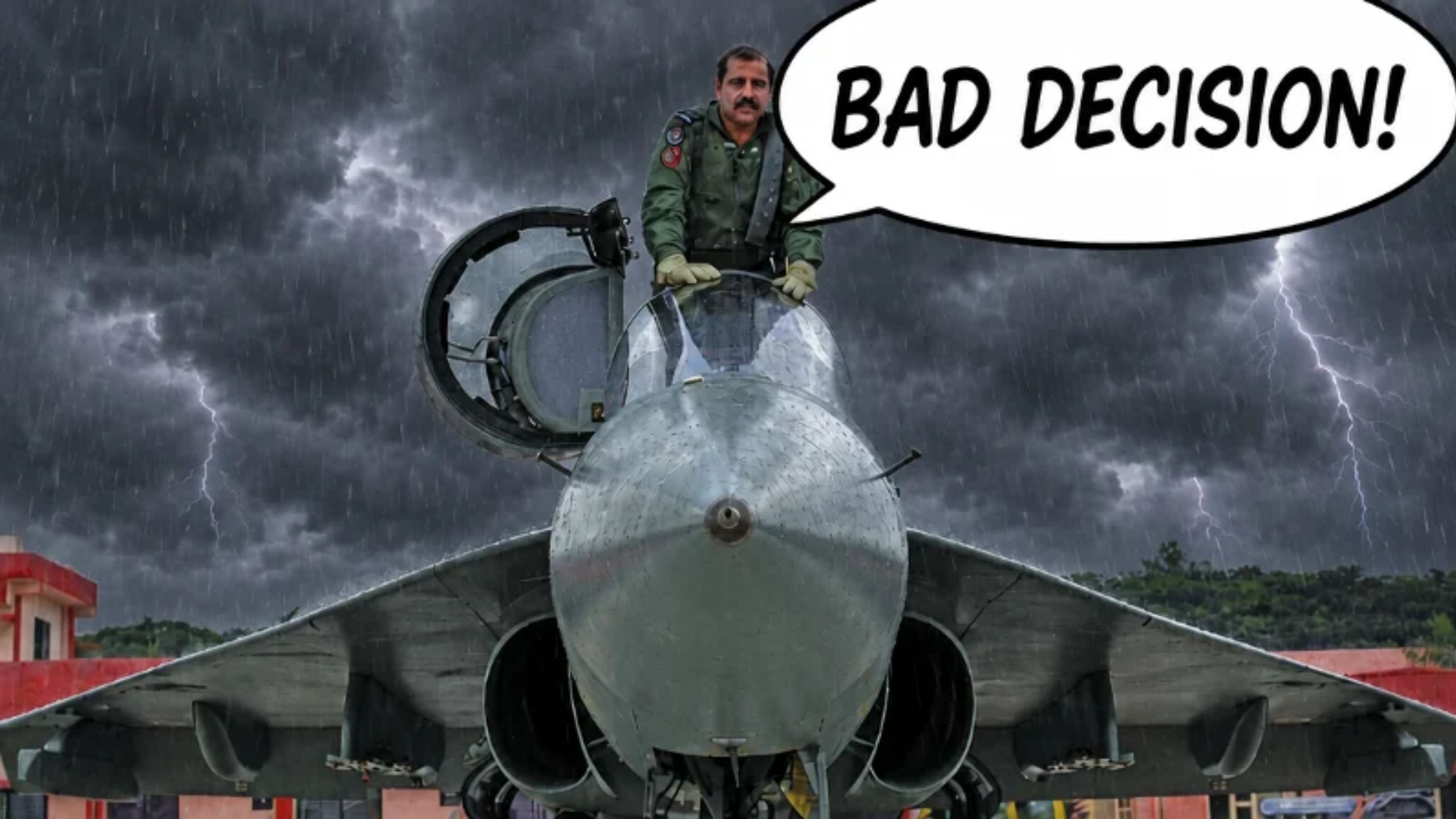
In a strikingly direct assessment of India’s indigenous military aviation ecosystem, former Chief of the Air Staff Air Chief Marshal R.K.S. Bhadauria (Retd) has termed state-run airframer Hindustan Aeronautics Limited’s (HAL) choice to bypass the homegrown Uttam AESA radar in favour of additional Israeli radars for the Tejas LCA Mk1A a “bad decision.”

Speaking on the NDTV Ctrl+Alt+Defence podcast co-hosted by Livefist founder Shiv Aroor, ACM Bhadauria outlined a detailed critique of institutional bottlenecks within HAL, revealed developmental hitches surrounding the LCA Mk2’s undercarriage, and provided critical context on the forward momentum of India’s 5th-generation Advanced Medium Combat Aircraft (AMCA) program now that private sector bids are formally in.

ACM Bhadauria expressed sharp disappointment over what he characterised as HAL’s reluctance to commit aggressively to the indigenous Uttam Active Electronically Scanned Array (AESA) radar, developed by DRDO’s Electronics and Radar Development Establishment (LRDE). Despite trial data confirming that the indigenous sensor surpasses the performance of imported alternatives, HAL recently opted to procure further tranches of the Israeli EL/M-2052 AESA radar for the LCA Mk1A fleet.

“I hear that HAL has gone in for more of the same radar and not taken Uttam, which is a bad decision to my mind, because even if it means a little delay, in any case the aircraft itself has got delayed,” Bhadauria stated. “What delay are we talking of that ‘radar integration is delaying me 1 year, 1 and a half year’? That is the importance we need to give to the indigenous system.”
He emphasized that the Uttam radar has fully matured and earned its operational credentials: “I am aware of Uttam. I think Uttam has already come of age. It is already ready for induction, integration onto the aircraft.” He further noted that flight test data gathered by the National Flight Test Centre (NFTC) proved its technological superiority: “It is already giving more range than the radar that we are already integrating on 1A.”
Addressing why HAL chose to stick with foreign hardware, Bhadauria pointed out a systemic preference for ease over enterprise. “At times they just pick up from abroad because it is easier to certify, it is faster, there are no risks involved,” he noted, adding candidly: “HAL already was co-producing that other radar. That would have been their larger interest, I would say to put it very bluntly, more than anything else.”

Turning to the medium-weight LCA Mk2 program, Bhadauria offered fresh detail on what has slowed down the prototype’s timeline, pointing specifically to landing gear development issues.
“From where they are now, there’s been some delay. I think some of the delay was undercarriage related. They got into some problem,” Bhadauria revealed.
While acknowledging that design and development (D&D) challenges are par for the course in complex fighter jet engineering, he called for accelerated work routines and advanced testing methodologies to recover lost ground. “D&D delays we have to give it to HAL, but I also want HAL and everybody involved in this to move much, much faster,” he said.

He urged the development agency and HAL to aggressively compress the flight-test schedule using modern digital tools. “There is a huge case for using technology and particularly AI-enabled technology for compressing all our plans of the future. I don’t think we are seriously working there. If you get all this into it, I think we’ll hack it.”
ACM Bhadauria did not pull punches when evaluating HAL’s broader corporate ethos, project management track record, and reinvestment culture. He highlighted an urgent need to break out of rigid public-sector routines:
“Project management has been disastrous at HAL… If you expect government organizations to manufacture and be as efficient as private, it will never happen.”
Recalling earlier efforts to establish a Special Purpose Vehicle (SPV) for the stealth AMCA project, he explained that the initiative failed because HAL insisted on dominant control. “If you keep HAL as the majority, it is same procedure, same sense, your control remains same… It was not a lack of interest from the private sector; it was lack of interest for the terms and for the kind of combination that was presented to them.”

Addressing HAL’s exclusion from the ongoing private-led AMCA manufacturing bidding process, Bhadauria confirmed that HAL’s proposal stumbled on basic compliance. “One of the partners did not meet the technical criteria. The criteria that the partners were to meet, those criteria were not met.”
Defence Secretary R.K. Singh had revealed this on a previous episode of the same podcast recorded at the NDTV Defence Summit.
Criticizing HAL’s sluggish pace on futuristic technologies like the CATS (Combat Air Teaming System) Warrior CCA, Bhadauria underscored a chronic lack of internal R&D funding. “If you just see how much money our DPSUs are putting in research, it’s bare minimum. There’s no reason they should have not been putting 15 odd percent into research.”
Calling out the lack of round-the-clock intensity at manufacturing units, he remarked: “We need to work three shifts. I keep saying I never see lights on at night. That means we are not working. If you think that in one, one-and-a-half shift you will change the scene in this country, it won’t happen.”
With private sector consortium bids now formally submitted for the execution of India’s 5th-generation AMCA prototype phase, Bhadauria framed the development as a crucial inflection point for national aerospace.
He dismissed suggestions that the target timelines are unachievable, noting that industrial capability within India has matured significantly over the past decade. The primary task now, he noted, is executing contracts swiftly and ensuring that state machinery actively supports the winning private entity.
“Now is the start point that we should worry about and see that there are no delays from now. I don’t see any reason why we should now slip on times,” Bhadauria asserted. “Once this kind of contract and this kind of attention is given, whoever is chosen, he will deliver. But I must also say that there will be a lot of support that is required across the board.”
He highlighted that certification agencies and government institutions must adjust their operational mindset to work seamlessly with private defence partners: “There’s a lack of proactive action in terms of certification agencies dealing with private sector. The way they deal with DPSUs is different than the way they deal with private sector. These are all ground realities. So we have to grow out of it.”
Despite his detailed critique of past missteps, the former Air Chief emphasized that the defence establishment cannot afford to remain bogged down in historical recriminations or inter-agency friction.
Refusing to assign single-point blame for historical delays, Bhadauria insisted on collective accountability and a unified push forward. “We should go beyond blame games. I think we all have a hand in this because we all had responsibilities. If we had moved faster, found a way to sort out the issues, we would have been faster.”
“The delays are past us and we shouldn’t worry too much about what has happened. We should at least now get it right,” Bhadauria concluded. “It has to be about a national will to move these things forward… National will, and then putting our contracts with our own industry and having full faith in it and everybody in the chain supports it. I don’t see any reason why we cannot succeed.”
Watch the full podcast episode here:
