

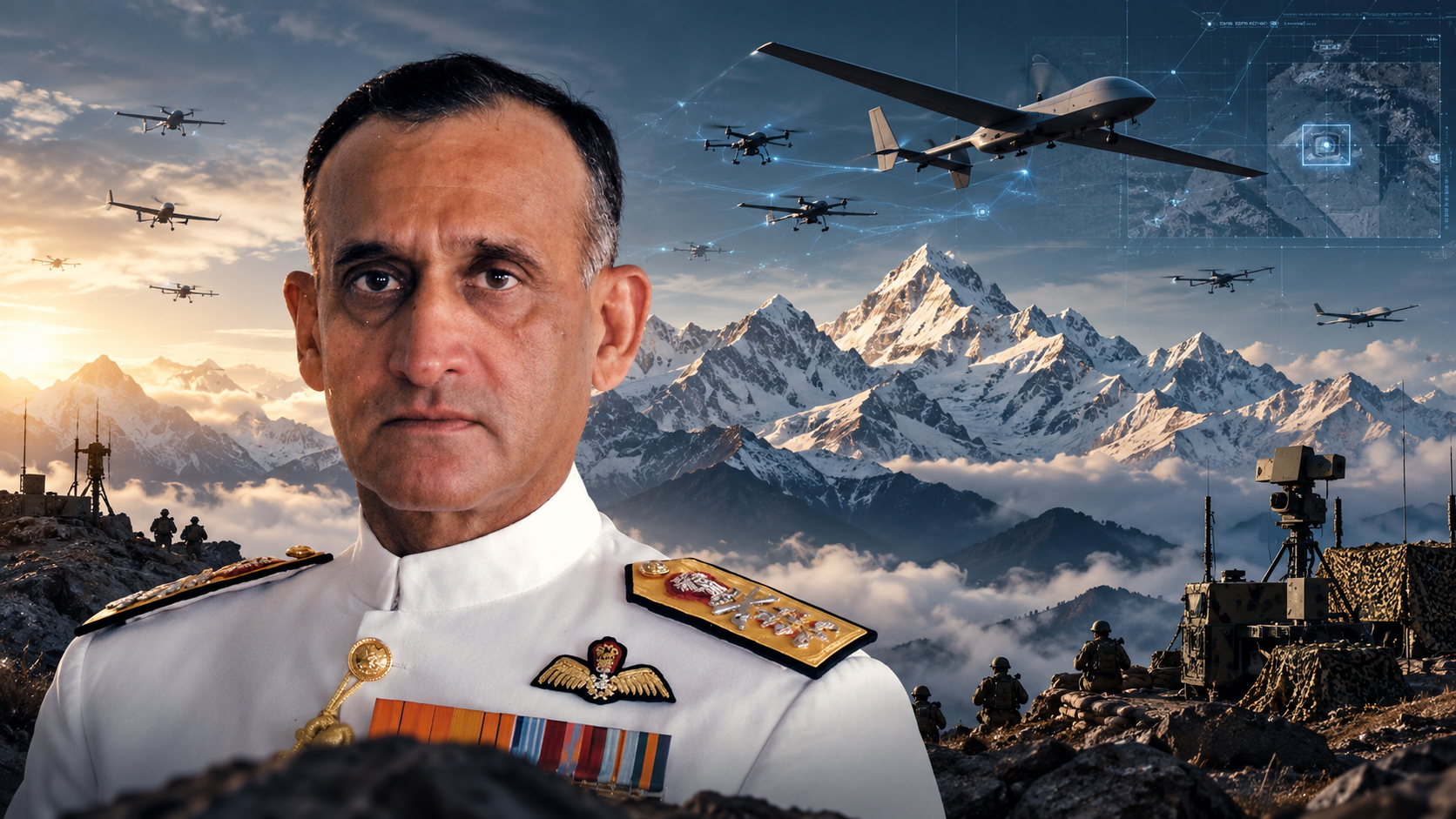
When General David Petraeus, former Director of the CIA and commander of US forces in Iraq and Afghanistan, delivered his prescription for modern warfare at the NDTV World Summit last week, it reverberated sharply through India’s national security corridors. His message was stark: future battlefields will be dominated by drone swarms, cheap autonomous weapons, and algorithmic warfare where traditional maneuver assets like tanks, surface ships, and manned aircraft face extreme vulnerability. In Petraeus’s view, every military on Earth requires a top-to-bottom institutional revolution, unlearning legacy concepts, overhaul of procurement cycles to weekly software iterations, and turning force structures on their heads.
However, when applied to India, a country that only recently nearly went to war with one nuclear neighbour, has an ongoing military standoff with another, how realistic is this radical prescription?
On NDTV’s India Matters, anchored by LivefistDefence.com founder Shiv Aroor, former Chief of the Naval Staff Admiral Arun Prakash, a 1971 war hero and naval aviator now a strategic affairs commentator, delivered a sobering, unvarnished reality check from the perspective of India’s military establishment. While acknowledging Petraeus’s insights into Ukraine and the Middle East, Admiral Prakash outlined why India remains dangerously far from executing such a transformation, constrained by structural inertia, political distraction, and a widening technological gap with China.
General Petraeus urged militaries to throw out legacy playbooks and embrace rapid institutional change. But as Admiral Prakash pointed out, the Indian defence ecosystem historically struggles with even routine administrative shifts, making a revolutionary leap nearly unthinkable under current conditions.
“Executing a revolution is not something easy especially in military affairs where… we are very conservative and unfortunately in India even routine issues take years and decades to implement so bringing about a revolution is… a little out of our reach.”
To underline the point, Admiral Prakash highlighted India’s agonisingly sluggish pace of structural reform:
“To take ordinary decisions like reorganizing our 17 commands into theaters has taken 6 years after the government gave an express order directive to the newly minted Chief of Defence Staff… We need to go well back in 2001 when the group of ministers following the Kargil episode directed the constitution of the Strategic Forces Command and the Andaman Nicobar Command—those were the first baby steps towards jointness, but 25 years have passed.”
The root cause, according to the former Navy Chief, lies in a fundamental disconnect at the top of the decision-making pyramid.
“…These things need to originate at the political level… My feeling is that the political establishment is far too much involved in politics and not enough in national security.”
The rapid evolution of unmanned surface vessels (USVs) and loitering munitions in ongoing global conflicts has already altered naval and aerial warfare dynamics, a key point made by Gen Petraeus. Admiral Prakash highlighted how non-state actors and nations without conventional navies are inflicting asymmetric damage on major powers:
“If you look at Ukraine, the country doesn’t have a navy to speak of but they’ve decimated the Russian navy… sank their flagship the Moskva… The Russian Navy is clinging to the east coast of the Black Sea… If you look at Iran, their air force has been decimated by the Americans and the Israelis, and yet they’ve got the Americans on the run—they’ve rained missiles and drones on 14 US bases in West Asia. Tanks and infantry are rarely seen on the Ukrainian battlefield… all these are factors which lead to what we are calling a revolution.”
India stands on the verge of allocating tens of billions of dollars toward heavy capital platforms, including potentially a third aircraft carrier, conventional and nuclear submarines, and 114 Rafale fighters. Admiral Prakash questioned whether committing scarce capital to long-gestation legacy platforms makes sense when the global balance is shifting toward algorithmic warfare.
“We are on the cusp of spending a great deal of money on weapon platform acquisitions whether it’s an aircraft carrier, submarines, or fighter aircraft… Projects like AMCA are about 10 to 15 years from realization. Should we be spending money on these kinds of platforms, or should we switch now and put money into artificial intelligence, algorithmic warfare?”
Comparing India’s technological readiness with Western developments reveals a stark gap:
“The Maven Smart System project was kicked off by the US armed forces… 10 years ago… Today they have something called the Maven Smart System. We don’t even have a large language model. We don’t even have a search engine which we can call Indian.”
Given the time required to build true indigenous technological depth, Admiral Prakash offered a grim tactical assessment:
“If we are going to try to catch up with China, then we need a spell of peace. Therefore, our politicians, our statesmen, and our diplomats need to ensure that we have a 10 to 15-year period of peace… which will allow us the breathing spell to catch up.”
General Petraeus asserted that the human is no longer “in the loop,” but rather “on the loop”, supervising systems that execute targeting at machine speed. Admiral Prakash cautioned against removing human moral judgment from lethal kill chains, citing ethical failures already visible in contemporary combat:
“…Theoretically speaking, it’ll be a sad day if the human being is taken out of the loop because AI is already galloping… There has to be a human being in the loop to exercise ethical caution and precaution… No matter how advanced the systems get, military ethics demands that we keep a man in the loop so the final trigger or the firing button is pressed at the behest of a human being…”
A core theme of Admiral Prakash’s critique was India’s tendency to create national security catchphrases that obscure a lack of concrete capability on the ground.
“We have conclaves, samvads, and seminars… but really are issues of contention subjected to debate and thrown about?… We need to catch the bull by the horns and realize how far astern, how far back we have been left behind. Examples of things like integrated battle groups, Cold Start, preferred security partner, etc.—those all turned into slogans; nothing happened after they were mouthed.”
He singled out critical technology bottlenecks, such as the decades-long struggle to develop an indigenous jet engine:
“Issues like the Kaveri engine… unless we have an aero-engine, our aerospace industry, we can bid goodbye to it… and there again, it’s a lack of political will, lack of funding, lack of intervention at the right point.”
He warned that entering a conflict without addressing these core deficiencies risks severe consequences:
“I think we are chasing too many mirages and issues which are not really of substance. So we need to come down to earth, face the reality, smell the coffee of what’s going to happen tomorrow, and either we gird our loins and tackle the problems, put money where our mouths are… If we go into a conflict with our present organization of 17 commands scattered all over the country and our archaic system of doing things… I don’t see a very happy future.”
The most glaring contrast, according to both Gen Petraeus and Admiral Prakash, in military planning across the Line of Actual Control (LAC) lies in China’s disciplined, step-by-step execution. While Beijing formulates regular Defence White Papers and builds vast industrial capacity, India still lacks a published National Security Strategy.
“China is very clear-eyed and resolute about where it stands… They produce a defence white paper every two years… You can make out what a clear-eyed vision they have… We have even denied the need for a national security strategy. So if we don’t know where we are going, how will we get there at all?”
The disparity in industrial manufacturing capacity is equally striking:
“China’s shipbuilding capacity is about… 20 times that of the USA. They can churn out an aircraft carrier in two to three years, we took 16 years. They’re pushing out destroyers and frigates in matters of weeks and months…”
Admiral Prakash concluded with a call for self-examination, warning against taking refuge in economic headline numbers or grand political slogans:
“We’ve declared ourselves a Vishwaguru already, but technologically we are ages behind China… We repeat ad nauseam that we are the third largest or fourth largest economy in the world. I don’t think that matters, it is the per capita GDP that is going to matter… So I think we need to smell the coffee, keep in touch with reality, especially where national security is concerned.”
General David Petraeus’s vision of future warfare provides an important benchmark for modern militaries. However, Admiral Arun Prakash’s intervention serves as a necessary, sobering reality check. High-concept military theories cannot substitute for clear national security strategy, sustained R&D funding, political focus, and streamlined procurement. Until India moves past slogans and addresses these foundational gaps, adapting to the future of warfare will remain an uphill climb.
Watch the full interview here:
youtube.com/watch?v=hwDk2M2NpVM&source_ve_path=NzY3NTg&embeds_referring_euri=https%3A%2F%2Fgemini.google.com%2F&embeds_referring_origin=https%3A%2F%2Fgemini.google.com
