
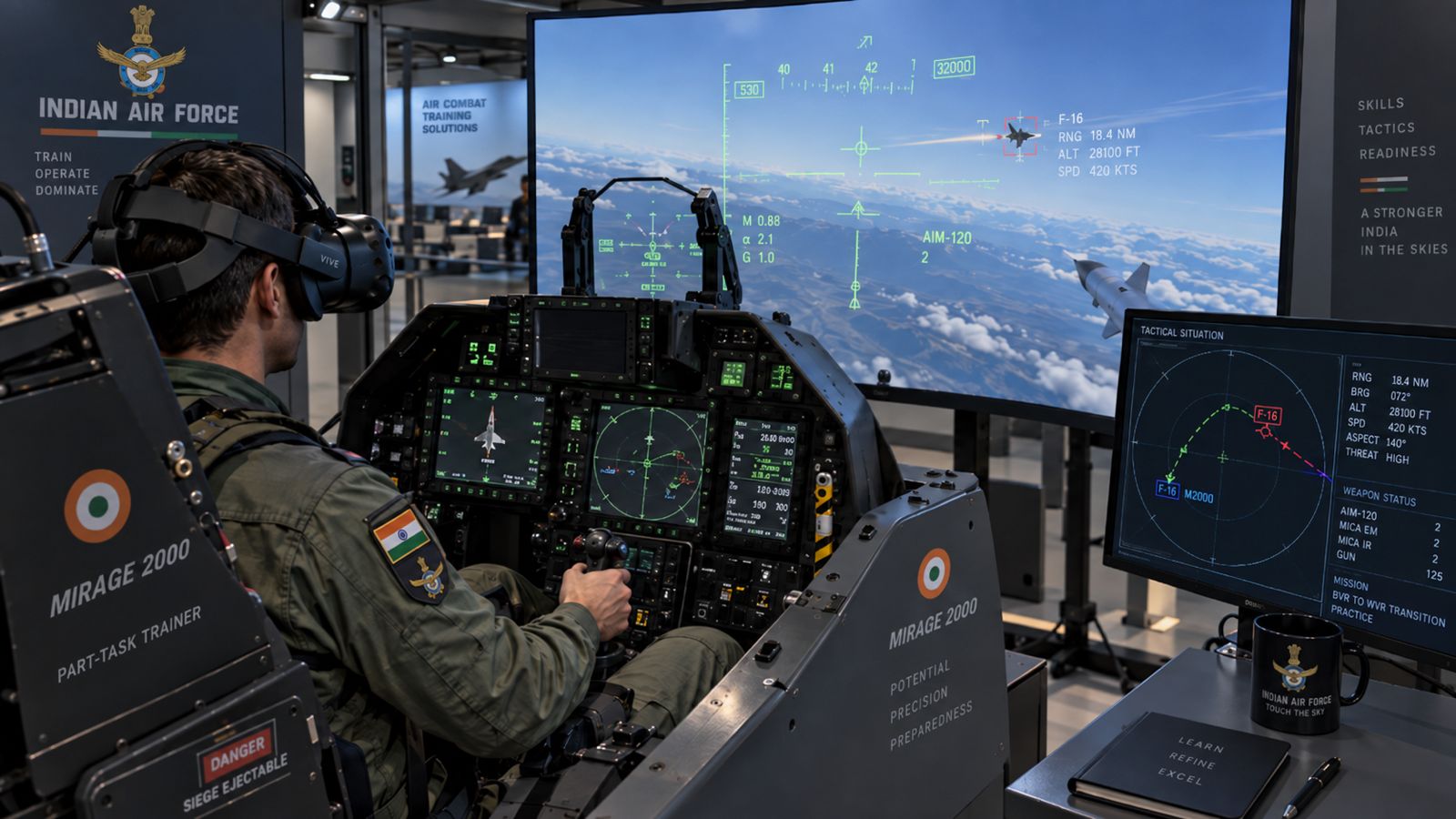
The Indian Air Force has signed a $14 million (₹135 crore) contract with Indian startup Threye Interactive, a subsidiary of NewSpace Research & Technologies, to develop part task simulators for its Mirage 2000 fighter jets. The deal will give pilots a new way to practice demanding combat procedures on the ground, particularly those needed when large numbers of aircraft operate together.
At ₹135 crore, the contract may be modest in the IAF’s larger procurement scheme of things, but it is a major win for a startup. More significantly, it shows the IAF trusting an Indian startup with training for a frontline fighter fleet. Threye is being asked to help prepare Mirage 2000 pilots for complex combat missions, a job with a direct bearing on operational readiness.
A part task simulator focuses on a specific part of a pilot’s job. Instead of recreating an entire flight from takeoff to landing, it allows pilots to repeatedly practice tasks such as using the radar, identifying a target, selecting a weapon or responding to a threat. A pilot can work through a difficult sequence, review mistakes and try again without using an actual fighter or consuming flying hours.

For the IAF, the wider application is large force combat training. A major air operation requires pilots to do more than fly their own aircraft well. They must keep track of friendly fighters, react to enemy aircraft and ground defences, and make decisions as the mission changes. Simulators allow such situations to be rehearsed repeatedly, including scenarios that would be difficult to stage in the air.

The aircraft at the centre of the contract, the trusty French-built Dassault Mirage 2000, has been part of the IAF for four decades. India inducted the delta-winged fighters in the 1980s, and the fighter became one of its most valued precision-strike platforms. It played a prominent role in the 1999 Kargil conflict and was again in the spotlight during the 2019 Balakot air strike.
The Mirage fleet has also undergone a major upgrade, executed by maker Dassault Aviation, Thales and Hindustan Aeronautics Limited to modernise the aircraft.
Threye’s connection with the Mirage goes back further than this contract. Its 2013 PC game Operation Morning Glory put players in a Mirage 2000 on a fictional mission deep into enemy territory. Former IAF fighter pilot Sameer Joshi (who went on to found NewSpace, which now owns Threye), who had flown the Mirage himself, was involved in its development. It was a game rather than a military training device, but it marked an early step in Threye’s work combining aircraft modelling with interactive missions.

The company later developed Indian Air Force: A Cut Above, the IAF’s official mobile combat game released in 2019. It allowed users to fly aircraft from the service’s inventory and complete missions, while also giving young people information about joining the Air Force. An upgraded multiplayer version followed later that year. That project was built for public engagement and recruitment. The new Mirage simulators are intended for the training of serving pilots.
In 2025, Threye also made a first-of-its-kind demonstration of a fighter and an uncrewed combat aircraft carrying out a paired mission. The demonstration drew on Air Combat Intelligence Development, or ACID, an initiative associated with its parent company, NewSpace. The idea is to develop the intelligence and coordination needed for a piloted fighter to work with an autonomous aircraft during an air combat mission.
That connection makes the Mirage contract part of a larger shift for the group. NewSpace has made significant inroads into military drone programmes, including work to develop an Indian collaborative combat aircraft, or CCA, for the Indian Navy designed to operate alongside piloted fighters. Its projects also include the Sheshnaag attack drone and other systems for the armed forces. For Threye, the new contract brings its experience in digital air combat missions back to the Mirage 2000, the fighter it first put on a computer screen more than a decade ago.
Threye’s Anurag Rana has written for Livefist before and been an art contributor.